Learn more
Digital tools that log, track, and report the time consumed by a project are employee timesheet apps. If you are a manager or a team leader, you need accurate data on working hours and want a breakdown of how time is distributed. You are a qualified candidate for using this app.
Unlike a basic punch-clock system or spreadsheet logs, modern timesheet software connects the time data directly to project budgets, resource planning, and payroll, giving agencies a complete picture of where effort goes.
In this blog, you will come across 15 employee timesheet apps that make time tracking and management feel like a breeze.
An employee timesheet app is a software designed to capture, manage, and report employee work hours. It connects time logs to clients, projects, and tasks. It is now possible to track billable and non-billable hours, manage project budgets, and generate reports.
Did You Know?
MGI (2025) indicates that the transition from manual to automated
time-tracking systems can recover 12-15% of
previously unbilled professional service hours. This directly improves bottom-line EBITDA by up to 5%
through the mitigation of systemic revenue leakage.
Source: MGI
Imagine it’s Friday evening, and you have completed all the tasks. All that is left is submitting timesheets. A few tasks don’t get logged because they seem irrelevant. Some hours are rounded off here and there. A couple of things forgot their way to the timesheets.
Sounds harmless, right? But when this happens all across the team, it compounds, and the gaps become broad.
On paper, everything looks on track. But then things start to show. Next week's planning gets blurred. You end up figuring out who is doing what, and keep going in circles. One team member is too overloaded. One is playing video games all day. And all of it goes unnoticed, until it’s too late.
For micro and small teams, it's still manageable as everything is on the table at the end of the month. But when teams are distributed across time and locations, it becomes a lot more complex. You don’t know where the time is going, and the numbers don’t add up.
This is exactly the situation an employee timesheet application prevents. It makes timesheet entries easier and consistent. The work is logged when it happens. Not as an afterthought. You and your agency can manage distributed teams easily, follow up constantly, and get live updates.
| Tool | Best Features | Best For | Pricing |
| eResource Scheduler | Resource scheduling + timesheets + financials + management reports | Agencies needing end-to-end visibility | Module-based options from $5/resource/month annually |
| Harvest | Simple time tracking + invoicing | Freelancers & small agencies | Plan-based options from $11/seat/month annually |
| Toggl Track | One-click timer, visual reports | Remote teams tracking billable hours | Plan-based options from $9/user/month annually |
| Clockify | Unlimited users free tier | Budget-conscious teams | Plan-based options from $4.99/seat/month annually |
| Jibble | Facial recognition clock-in | Field & distributed teams | Plan-based options from $5.99/seat/month annually |
| My Hours | Detailed project time tracking | Small teams & consultants | Plan-based options from $4/user/month annually |
| Hubstaff | GPS + automated time tracking | Field service & remote workforce | Plan-based options from $4.99/user/month annually |
| QuickBooks Time | Payroll-integrated timesheets | QuickBooks users | Plan-based options from $20/user/month annually |
| Buddy Punch | Punch clock + scheduling | Hourly workforce management | Plan-based options from $4.49/user/month annually |
| Wrike | Project management + time tracking | Mid-to-large project teams | Plan-based options from $10/user/month annually |
| Asana | Task-based time tracking | Teams using Asana for projects | Plan-based options from $0.99/user/month annually |
| Everhour | Deep project budget tracking | Agencies billing by project | Plan-based options from $6/user/month annually |
| Teamwork | Client-facing time & billing | Client service agencies | Plan-based options from £9.99/user/month annually |
| ClickTime | Workforce capacity + compliance | Professional services firms | Plan-based options from $12/user/month annually |
| Scoro | All-in-one agency management | End-to-end agency operations | Plan-based options from $23.9/user/month annually |
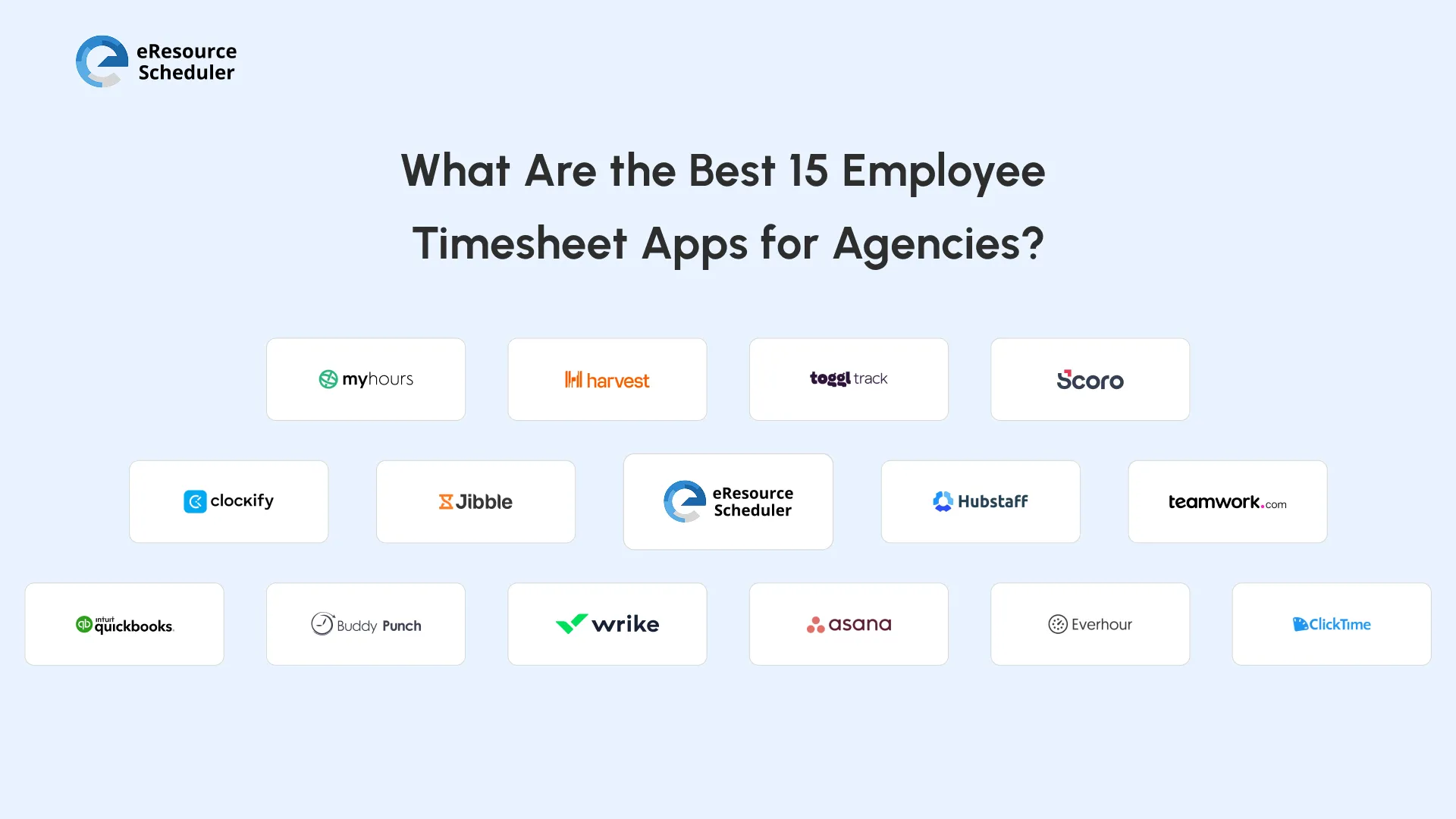
Confused about which app works best for your agency? Below are the detailed notes on the 15 best employee timesheet apps for agencies. We tried to cover what each tool does well, what it lacks, and what it will cost as clearly as possible.
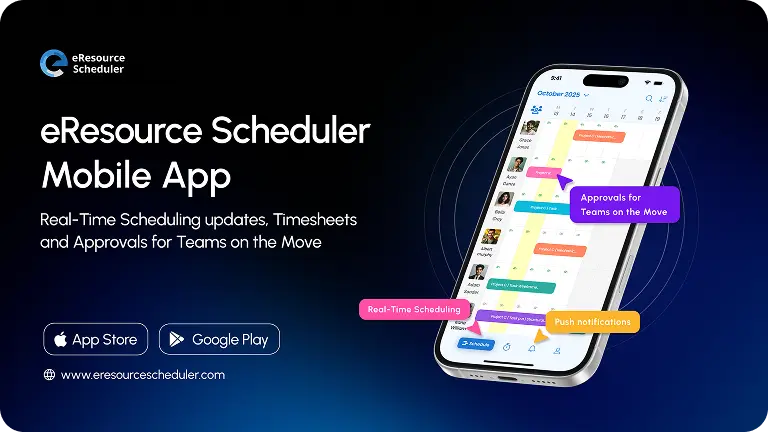
eResource Scheduler is your all-in-one enterprise resource management software. Unlike standalone time tracking tools, it brings scheduling, timesheets, financials, management reports, and capacity planning under a single umbrella.
Wondering how it will benefit you as a remote-first company dealing with different agencies? And each one has a different profile. Worry not. eResource Scheduler is industry-agnostic. It is also available as a web and a mobile app. This makes it compatible with remote and hybrid teams.
The timesheet captures planned vs actual efforts of resources across projects. Your employees can log time from a desktop or a mobile, and you get instant visibility into variances between scheduled and logged hours. With the cross-functional dashboard view, you can also see time distribution across all resources and projects.
One User Remarks:
“I use eResource Scheduler to coordinate technical teams and network specialists across multiple
regions. The planned vs. actual visibility helps us spot when a project is going over hours within days, not
weeks. That early signal gives us time to course-correct before it affects the budget, instead of only
realizing the overrun when invoices are already out.”
Source: G2
Free Trial: Available
Want to track time, manage resources, and monitor project budgets, all in one place? Explore the eResource Scheduler's timesheet and resource scheduling modules.

A time tracking and invoicing tool focused on recording billable hours. Are you a freelancer, a small agency, or a client service team? Then this tool is for you.
| Strengths | Drawbacks |
| Timer-based time tracking | Reporting is relatively basic |
| Alerts when hours approach the set limit | Gets expensive for large teams |
| Built-in invoicing that converts time logs to client bills | Limited resource scheduling features |
Free Trial: Available
A tool with a one-click timer and a minimal-friction approach to time tracking. It is for remote and distributed teams that need a fast, easy way to log hours across projects and clients.
| Strengths | Drawbacks |
| One-click timer | No built-in invoicing |
| Browser extension | Free plan limited to 5 users |
| Color-coded project reports | Limited resource scheduling features |
Free Trial: Available
One of the free employee timesheet apps available. Provides time tracking, project, and task organization. Used by agencies and teams just starting to formalize time tracking.
| Strengths | Drawbacks |
| Kiosk of shared clock-ins | Interface feels cluttered |
| Timer, timesheet & calendar views | Lacks advanced reporting |
| Attendance & leave tracking (paid plans) | Time entry editing is tedious |
Free Trial: Available
Looking for a time-tracking app with attendance management? Now you have your solution. This app has GPS tracking to verify locations. It can also schedule a shift for you.
| Strengths | Drawbacks |
| Built-in leave tracking | UI is more HR-focused |
| Real-time attendance dashboard | Falls short on advanced reporting |
| Payroll integrations with platforms like ADP | Project-based time tracking feels shallow |
Free Trial: Available
A user ranted, “My overall experience has been time consuming and irritating. It is not able to adjust
to a fiscal year instead of a calendar year. On January 1st, everything resets.”
Source: Capterra
It's for you if you are a small team, want detailed timelogs, and basic reporting. Also supports task-level time tracking, billable rate setting, and simple client reports.
| Strengths | Drawbacks |
| Client-facing reports | Limited integrations |
| Billable vs non-billable tracking | No resource management features |
| Budget tracking indicators | Not ideal for agencies with complex structures |
This is a fair deal if you want tracking, GPS, scheduling, payroll integrations, and project budgeting in one platform.
| Strengths | Drawbacks |
| Automated time tracking | Some features require higher plans |
| Project budgeting with alerts | Pricing compounds quickly with add-ons |
| Scheduling and shift management | Activity monitoring and screenshots are invasive |
Free Trial: Available
A time tracking and scheduling tool tightly integrated with the QuickBooks ecosystem. Includes GPS tracking and shift scheduling for field teams.
| Strengths | Drawbacks |
| Native integration | Very expensive |
| Labor law compliance | Value for money for QuickBooks users |
| Real-time crew management | Rigid reporting outside QuickBooks workflow |
Free Trial: Available
An hourly time tracking and scheduling tool. Your employees punch to clock in and out. You track their attendance, overtime, and schedules.
| Strengths | Drawbacks |
| Payroll export | Less suited for projects |
| Multiple clock-in options | Reporting depth is limited |
| Automatic overtime calculations | Pricing is significant as teams grow |
Free trial: Available
Project management platform that tracks time. If your agency is already using the software, it will be practical to opt for this option.
| Strengths | Drawbacks |
| Customizable dashboards | Less suited for time-tracking |
| Request forms and intake workflows | Complex to set up for newer teams |
| Task-level time logging connected to timeline | Advanced features require higher-tier plans |
A very disappointed user reported, “Wrike is not very user-friendly, and its project structure
doesn’t effectively support practical project management. The calendar views are difficult to
navigate, tagging projects is cumbersome, and there are no pre-built sections or tags for tracking
budgets.”
Source: G2
Free Trial: Available
A management tool with time tracking through native integrations. It is not a dedicated timesheet app. But it works well as a part of an ecosystem.
| Strengths | Drawbacks |
| Task-based time estimates | Native time-tracking is limited |
| Automated workflows and approvals | Timesheets require additional tools |
| Reporting dashboard across project portfolios | Not an ideal standalone timesheet software |
Free Trial: Available
A project time tracking and budget tool for agencies and professional services. Will do project budget tracking, bill-by-project billing, and cost control for your agency.
| Strengths | Drawbacks |
| Budget tracking | Pricing is high |
| Estimates vs actual hour reporting | Standalone use limits functionality |
| Invoice generation based on tracked time | Requires an existing project management tool |
Free Trial: Available
A project team management and client collaboration tool. It has built-in time tracking to see the time logged by person or project. Generate reports that are ready for clients.
| Strengths | Drawbacks |
| Invoice generation | Limited integrations |
| Resource management | Interface requires a learning curve |
| Billable and non-billable tagging | Features can feel complex for time tracking |
Free Trial: Available
A workforce capacity planning and time tracking platform. For professional services firms that need to track both employee hours and organizational capacity.
| Strengths | Drawbacks |
| Capacity planning | Pricing is high |
| Compliance time tracking | UI is enterprise-focused |
| Approval workflows for time submissions | Set-up requires complex configuration |
Free Trial: Available
A comprehensive agency management platform. For agencies that want quoting, project management, time tracking, billing, and reporting in one system.
| Strengths | Drawbacks |
| Resource planning | Pricing is high |
| End-to-end profitability management | Requires a steep learning curve |
| Real-time profitability dashboards per project | Full value needs multi-function usage at once |
A client remarked, “I had a generally negative experience using Scoro. I sometimes felt like I was using more time than I was saving (or being productive) while figuring out how to use the software and run reports for management meetings.”
Source: Capterra
Free Trial: Available
Expert Evaluation:
A workforce report by the Society for Human Resource
Management (SHRM) found that organizations using structured time tracking tools reduced
payroll errors by up to 25%, directly improving employee trust and financial accuracy.
When dozens of options are available, it becomes a task to choose one. Selecting the right application filters down to understanding the needs of your agency. Here are six evaluation criteria to guide your decision.
Before evaluating tools, know your billing model. If you bill clients by hours, you need billable hours tracking and invoicing. If you run a retainer-based account, budget tracking matters more. If you want to keep a log of your employee’s efforts without privacy invasion, you need flexible timesheet entries.
Distributed and remote teams benefit from mobile-first apps or software that provide a mobile app as well. Co-located teams may prefer shared dashboards. If your agency's hierarchy is complex, go for role-based access.
Pure time tracking tools let you plan what happened. Resource scheduling tools let you plan what should happen and then compare it to reality. For agencies that juggle multiple clients and projects, this visibility is a significant advantage.
If you are looking for software with scheduling and timesheets, consider eResource Scheduler. It has both features in one system.
Look for a timesheet tool that can fit seamlessly with the one you are already using. Just like a puzzle piece. Integration compatibility will reduce data re-entry.
Some tools offer free plans, but with limited features. When looking for a tool, evaluate the cost per seat against the features you actually see. Some tools offer plan-based options, others module-based.
Agencies that actively monitor project profitability need more than raw time logs. Look for tools that connect hours worked to project budgets and show plan vs actual reports.
Ready to move from scattered spreadsheets to a single system that connects scheduling, timesheets, management reports, and project financials? eResource Scheduler gives your agency the visibility to plan better, bill accurately, and grow profitably.

Choosing the right timesheet application is an operational decision. The best timesheet apps for agencies do more than just track hours. They connect your time data to project budgets, resource plans, and client billing. It gives you the visibility you need to run profitable, well-organized, and productive teams.
Do you need a free tool to get started? A simple billing-focused tracker? Or a full resource management and timesheet software? There is a right fit for your agency in this list. Start with what you need today and choose a tool that grows with you.
1. Why do agencies need time-tracking software?
Agencies manage multiple clients and projects simultaneously. Without time tracking, it is impossible to know whether projects are on budget, whether teams are overworked, or whether billing reflects actual effort. Time tracking software makes this visible, accurate, and manageable.
2. How to know if my agency needs a timesheet app?
If your team regularly ends projects over budget, if managers cannot quickly answer how many hours a project has consumed, or if your billing process relies on memory or estimation rather than logged data, your agency needs a timesheet app.
3. What best practices should I employ when using a timesheet app?
Log time daily rather than reconstructing it at the end of the week. Set up projects and tasks before asking employees to log time. Review timesheet reports weekly, not monthly. And connect time data to project budgets so you can act on variances before they become problems.
4. Can timesheet apps integrate with payroll software?
Yes, most timesheet apps integrate with payroll systems, allowing approved work hours, overtime, and leave data to sync automatically. This removes manual data entry and reduces errors. Payroll processing becomes faster and more accurate.
5. How do timesheet apps help improve project estimates?
Timesheet data shows how much time similar tasks and projects actually take. Agencies can use this to compare planned vs actual effort, adjust future estimates, and avoid underquoting work.


Plan Smarter. Schedule Faster. For Free.
Join thousands already using eResource Scheduler to align teams, time, and tasks seamlessly.
 ALL FEATURES INCLUDED