Learn more
It’s 7 AM, and your foreman is calling because the crew that was supposed to show up on Site B never left Site A. Nobody double-booked them on purpose. It just happened (as it always does) because the spreadsheet you updated yesterday afternoon was already out of date by this morning. If it sounds familiar, you already understand construction resource allocation better than any definition could explain it.
This is not a problem unique to your team or your company, and it rarely starts on the job site. It usually starts upstream, in whatever resource planning and management process you are currently trusting to keep everyone in the right place. Most construction teams patch these gaps with more calls rather than fixing the core system. Let’s look at what changes when planning is done right.
Planning well is less about predicting the future and more about seeing your resources clearly enough that surprises stop being surprises.
Good planning starts before the first crew shows up. When you can see your entire resource pool across every active and upcoming project, you can forecast what you will need weeks or months out instead of scrambling the week before. This is what separates planning a project from reacting to one.
Construction projects move through distinct phases, and each phase pulls on different resources. Foundation work needs different people and equipment than framing, and framing needs different resources than finishing. Getting construction resource management right at this level means mapping your workforce and equipment for each phase, so you are never over- or understaffed later.
The earlier you catch a resource conflict, the cheaper it is to fix. A scheduling clash caught during planning costs you an adjustment. The same clash discovered mid-project costs you rework, delays, and sometimes penalty clauses.
Industry Intake
Construction complexity is tied more closely to internal planning and leadership decisions than to the outside market forces. PMI’s 2026 Pulse of the Profession found that 53.3% of construction projects are considered complex. For construction, manufacturing, and energy specifically, the leading driver is evolving leadership demands and decision-making responsibilities, not market conditions.
What makes this worth paying attention to is how avoidable most of it is. A resource conflict rarely appears out of nowhere. It shows up in the data days or weeks before it turns into a real problem, only if you have a system that surfaces it earlier, and not bury it in a tab you forgot to update.
This is really the whole argument for planning with a tool instead of a spreadsheet. It is not about replacing your own judgement. It is about giving your judgment better information sooner.
The pattern holds up clearly when you put the two approaches side by side.
| Planning Factor | Manual/Spreadsheet Planning | Tool-Based Resource Allocation |
| Visibility Across Projects | Limited to whatever was last updated | Real-time view across every active project |
| Forecasting Accuracy | Based on memory and static files | Based on live capacity and demand data |
| Response to Scope Changes | Manual recalculation, often delayed | Immediate reallocation across the resource pool |
| Risk of Double-Booking | High, especially across multiple sites | Low, flagged automatically before conflicts happen |
| Time Spent on Admin | Hours per week collating updates | Minutes, since data updates continuously |
Planning solves a lot, but it does not eliminate every problem construction resource allocation runs into. Some challenges show up no matter how well you plan for them, and it helps to know what to watch for.
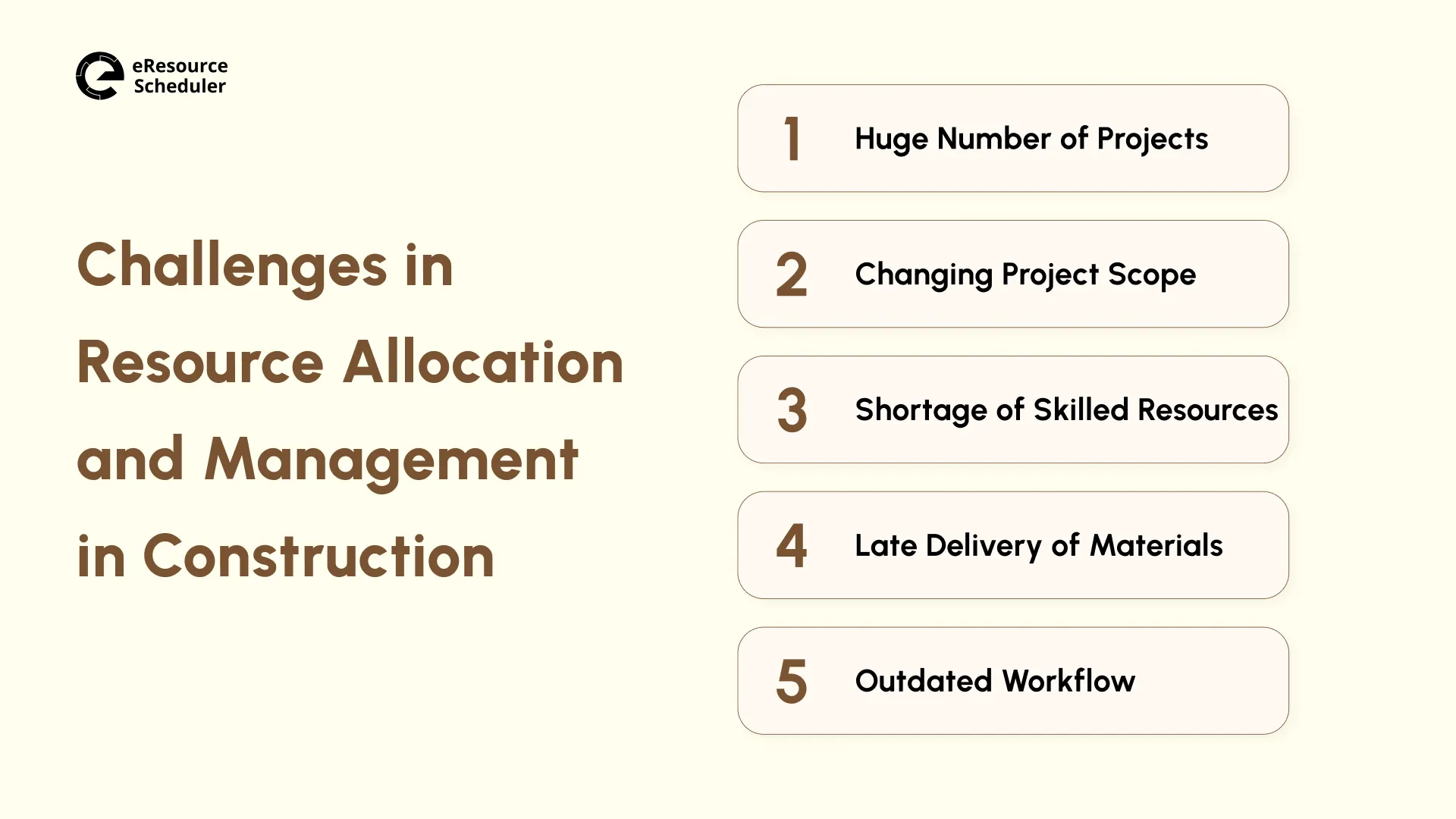
Most of these gaps trace back to a handful of recurring problems, and chances are you will recognize at least three of them from your own job sites.
When you are juggling multiple sites at once, you are essentially running several small businesses in parallel. Each one has its own schedule, its own crew requirements, and its own supply chain. You cannot allocate construction resources well when you are tracking all of this in separate files, or worse, in your head. The more projects you take on, the more resource conflicts multiply, not in a straight line but exponentially.
Though your projects might be meticulously planned, unexpected shifts are part and parcel of the job. A client changes the layout, a permit gets delayed, or the weather simply does not cooperate. Every scope change forces you to recalculate who is available and what it means for every other project pulling from the same resource pool. If you are not tracking this in real time, you are planning against information that is already stale.
You already know skilled labor is hard to find, especially in construction, where demand for crews keeps climbing. What often gets missed is how a shortage compounds resource allocation problems instead of just causing them. When you have fewer qualified electricians or crane operators than you need, every assignment decision carries more weight because there is no backup if you get it wrong.
Research Insight
According to Wellingtone's 2026 State of Project Management, resource management ranks among the hardest project processes to embed well, alongside benefits realization and project prioritization.
Materials sitting on a truck, and not at a job site, do not just delay one task. They delay every task lined up behind it. If your resource allocation plan does not count for material timelines alongside people and equipment, you are only solving part of the problem.
A crew standing idle because rebar has not arrived is still a resource allocation failure, even though the resource in question was never human. It costs you the same in wasted labor hours as a staffing mistake would, it just gets blamed on the supplier instead of the plan.
Many construction companies still lean on paperwork or spreadsheets for resource management and allocation. It is a low-cost habit, but it is also slow and error-prone. If you are tracking assignments manually, you can miss important resources or miscalculate the schedule without realizing it until it is too late.
Point to be Noted
If forecasting keeps slipping or your resource data never quite matches reality, you are not imagining it. The Resource Management Institute’s 2026 State of Resource Management found that forecasting is the most commonly cited process gap in resource management. 96% of organizations say their resource data still has reliability issues that need fixing.
Most project management software on the market was not built with job sites in mind. Construction operates on dependencies between trades, weather-driven delays, and equipment that has to physically move from one location to another. None of this fits neatly into a generic task tracker built for office teams. Trying to force this mismatch usually means working around the software instead of with it.
Once you know what usually goes wrong, the more useful question is what actually improves once you put a proper system in place.
Here is what actually improves once a dedicated resource allocation software becomes part of how your team works. Day to day. Project to project.
Over-allocating a crew burns people out and invites mistakes. Under-allocating leaves capacity sitting idle while deadlines slip elsewhere. Getting this balance right depends on understanding the difference between resource allocation and resource utilization, since assigning a resource and actually using it well are not the same thing.
Time tracking closes the loop between what was planned and what actually happened on-site. When hours logged match the schedule, you know your resource allocation decisions were accurate. When they do not, you get an early signal instead of a late surprise, which feeds directly into a clearer view of your resource utilization across every project.
Matching people to tasks based on actual skill, not just availability, changes outcomes on site. It also changes how the workforce experiences the job itself. Predictable, fair construction employee scheduling tends to improve morale and retention in ways that contractors usually underestimate.
Once your current projects start operating on predictable resource data, you can plan ahead with real numbers, not instinct. This confidence of knowing whether you can realistically take the next bid is really why resource allocation software has become central to project success for firms scaling past a handful of sites.
Most of the above benefits sound good in theory, but they depend entirely on having a system that can actually deliver them at the scale a construction business runs at. eResource Scheduler is designed to bring all the above under one roof, along with visibility, balanced workloads, time tracking, skill-based scheduling, and cost control. All of this without needing five different spreadsheets to hold it together.
Pini Group is a useful example of what this looks like in practice. Moving off manual tracking onto a dedicated resource scheduling system changed how their teams plan and staff projects.
You do not need to overhaul everything at once. Start by mapping out exactly where your current process breaks, whether this is double-booking, missed skill matches, or nobody catching a scope change until it's too late. This single audit usually tells you more than any feature list.
Once you know what is actually broken, pick one active project to test a resource allocation tool on before rolling it out everywhere. Treat it as a trial run, not a full commitment. Let your team get comfortable moving assignments around in the system, checking availability before promising a crew to a client, and logging hours as they go instead of at the end of the week.
Give it one full project cycle before judging results. Planning tools show their value most clearly in the moments that used to cause problems. The double-booked crew, the scope change nobody caught in time, the material delay that stalled three other tasks. If these moments start resolving themselves instead of becoming emergencies, you will know it is working.
There is a version of your next project where the schedule slips for the exact same reasons it always has. Then there is a version where it does not. The difference usually is not more people or more hours. It is whether you caught the conflict on a Tuesday afternoon, not a Thursday morning when the crew is already standing around waiting.
Most contractors do not realize how much of their margin is sitting inside decisions this small until they start tracking them. If you want to see how far this rabbit hole goes, these resource allocation tips are worth a look. Not because they will fix everything tonight. Because a few of them will probably make you rethink something you have been doing on autopilot for years.


Plan Smarter. Schedule Faster. For Free.
Join thousands already using eResource Scheduler to align teams, time, and tasks seamlessly.
 ALL FEATURES INCLUDED