Learn more
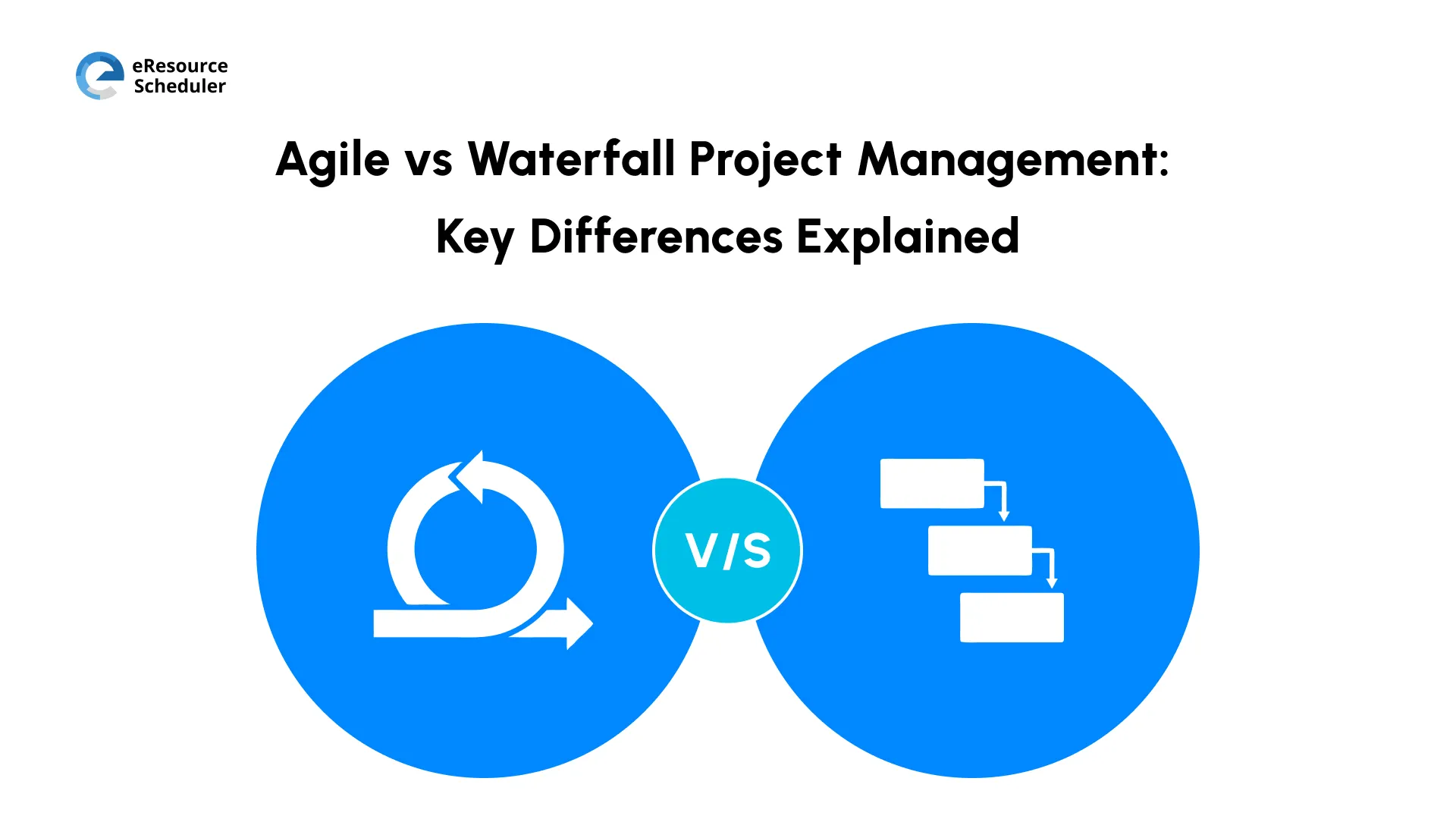
Most project failures aren't about the team. They are about the methodology mismatch. Agile and Waterfall are both battle-tested frameworks, but choosing the wrong one for your project is like using a scalpel when you need a saw.
Agile and Waterfall represent two fundamentally different philosophies about how work should flow, change, and get done. Understanding the real differences between them is not a methodology debate. It is a strategic business decision.
In this article, we will look at the differences between Agile and Waterfall project management and will guide you on finding the right one for you.
Waterfall approach in project management is a serial, step-by-step method in which every part of the project is completed in order prior to heading to the next stage. In Waterfall, often, resource management is stricter. It is comparable to a waterfall, in which successive phases are like steps.
There are distinct phases in the waterfall model:
1. Gathering requirements: All project requirements are gathered up front.
2. Design: The design stage begins following the requirements.
3. Implementation: The project's actual coding or construction takes place.
4. Verification: Testing is done.
5. Maintenance: The project goes through a maintenance phase after delivery.
Delivering the complete project is the goal. Each step must be finished before going on to the next.
Did You Know?
Adoption of hybrid project management models surged by 57% in just one
year, signaling that rigid methodology choices are rapidly giving way to blended approaches. (Source)
1. Needs less coordination as it has well-defined phases and sequential processes.
2. An obvious project phase serves to define the work dependencies.
3. The cost of the project can be estimated after the requirements have been established.
4. Improved attention to documentation of requirements and designs.
5. The design process is more systematic and organised before any programming for software.
1. More difficult to divide and communicate work due to the more rigid phase sequences. Teams are more specialized.
2. Risk of wasting time because of setbacks and delays in transitioning to other phases.
3. Other recruitment needs to complete the specialized phase, while agile promotes more cross-functional teaming.
4. Additional communication overhead at handoff across phase transitions.
5. Product ownership and involvement might not be as solid if compared to agile because the attention is brought to the present phase.
Agile project management, in comparison, is based on an iterative and adaptable process. It is not a linear process; you have the space to make tweaks here and there. Agile is typically used within software development but has other applications.
Major ideas and principles of agile development include customer satisfaction through early and continuous delivery of software, embracing changing requirements, delivering frequently working software, and ensuring close cooperation among businesspeople and developers during the project.
1. Faster feedback loops
2. Catches problems early
3. Greater potential for customer satisfaction
4. Time to market is significantly reduced
5. Better visibility/accountability
6. Single teams with better productivity over time
7. Flexible prioritization with a focus on value delivery
1. Critical path and inter-project dependencies can fail to be delineated as they are in the waterfall model.
2. There is an organizational learning curve cost.
3. Real agile implementation with an ongoing deployment pipeline has numerous technical prerequisites and engineering expenses to set up.

The general distinctions will guide your decision on the best technique for your project.
Waterfall: Phases are carried out one after another in a linear way. Once a phase is completed, it cannot go back to that phase.
Agile: The working project is divided into smaller cycles (sprints). After every iteration, the outcome is evaluated, and changes to the working process are made, if required.
Waterfall: Highly structured. Once planning and design are over, making changes becomes practically impossible.
Agile: Very flexible. Alterations are made on the go, eliminating what no longer works and responding to feedback and changing requirements.
Waterfall: The delivery of the project happens at the end, when all the phases have been completed.
Agile: The product gets delivered incrementally. The whole project unfolds with a series of releases.
Waterfall: Clients are involved only in the first phase (requirements) and the final product delivery.
Agile: Clients or stakeholders are involved throughout, giving feedback after every sprint.
Waterfall: Risks are more difficult to manage since there is no testing until the entire build is complete.
Agile: Risks are much more manageable as problems are found and fixed after every sprint.
Waterfall: It's all done in detailed plans for each stage.
Agile: Emphasizes working software instead of comprehensive documentation. Documentation is residual and grows over time.
Agile Methodology was derived from software development and is mainly for software development. Agile project management adopts an iterative methodology for development by creating several incremental steps with frequent intervals of feedback.
This fosters flexibility as a team can modify along the way of product development, as opposed to being stuck in a linear sequence. The biggest advantage is the common skill sets among the software team. The overlapping skill sets of the team bring flexibility to the work in every section of the team's codebase.
There are inevitable changes when it comes to requirements for a certain software project. The more the users are in contact with what they need, the more they evolve with their requirements, or sometimes, changes also occur as the conditions in the market change.
Spotify has been agile in its scaling process, and it's totally because it introduced Agile. A good representation of agile in action with cross-functional teams is Spotify with their squads and tribe model.
Marketing teams in professional services are using the methodology to organize high-velocity, dynamic campaigns. Marketers need to be continuously responding to the ever-changing trends in business and audience sentiment. The sprint cycles within Agile allow campaigns to be activated at speed, then rotated in response to insights.
This process is followed by Coca-Cola in defining its digital marketing campaigns. Granting their teams permission to pilot ideas and iterate in real-time based on audience measurements.
Startups are usually resource-constrained and face uncertain markets. Adapting to these changing market trends profitably is what Agile does best. The main agenda is to ultimately create an MVP, which lures the early adopters. Startups can iterate on their product affordably because of those repeated iterations.
Before scaling, Dropbox started with a minimum MVP and then slowly iterated depending on user feedback to ensure product-market fit.
Online learning platforms need to be flexible to meet the changing needs of learners in this modern world. Agile methodology allows the addition of features or courses in iterations. The platform is updated regularly based on student feedback.
This is what Khan Academy does so that their improved courses and user interface give the learners a much better education experience.
In a swiftly changing tech landscape, just like mobile applications need regular updates to stay up-to-date. The methodology works to provide feature enhancements or bug fixes and to align with new operating systems, applications value incremental releases and updates. It urges faster releases and user-centric design.
It is made possible by a principle of agile development that changes through time and integrates user feedback, taking Instagram from an application dedicated only to sharing pictures, transforming it into a multi-featured app.
Each of the two project management approaches, Waterfall and Agile, has its distinct phases. Let's compare how they approach the phases of this project starkly differently and in quite different ways of flexibility.
Having a shared vision for the project's goals and vision is the main goal of the inception phase, which is where the Agile process starts.
At this stage, people who have a stake in the project get together to set big goals and also define exactly what the project will do and cover. Unlike Waterfall, Agile has flexible requirements that are continuously improved upon as the project progresses.
The work is broken up into smaller, more manageable pieces called "sprints" within iterations. Teams plan, design new features, and then also test all that they build during done cycles, and these cycles usually last for two to four weeks. Each iteration builds upon the previous one to incorporate ongoing feedback, achieve refinement, and adjust to changes in the project scope. Agile's flexibility and ability to adjust to ongoing user feedback are made possible by iteration.
The requirement stage for the waterfall begins with collecting and thoroughly documenting all project requirements.
This phase specifies certain functional and important non-functional attributes of the product. Waterfall offers less flexibility than Agile due to its scope being very much set and little, if any, scope change occurring during the execution of the project.
In the Analysis and Design phase, the team members do a deep analysis of the collected details, what things should be like, and how they should work together.
Creating design documents and blueprints, and gathering other vital pieces of information to be fed into the next step, also form part of this stage. While Waterfall works within the design sphere in a very meticulous way to decide how things should be placed, Agile is all about navigating design in fast cycles.
In Waterfall, implementation comes next, following the design stage, when the development teams start coding and developing the product against the agreed design. Testing usually occurs at the end of implementation, as opposed to Agile testing and feedback in iterative cycles through the process.
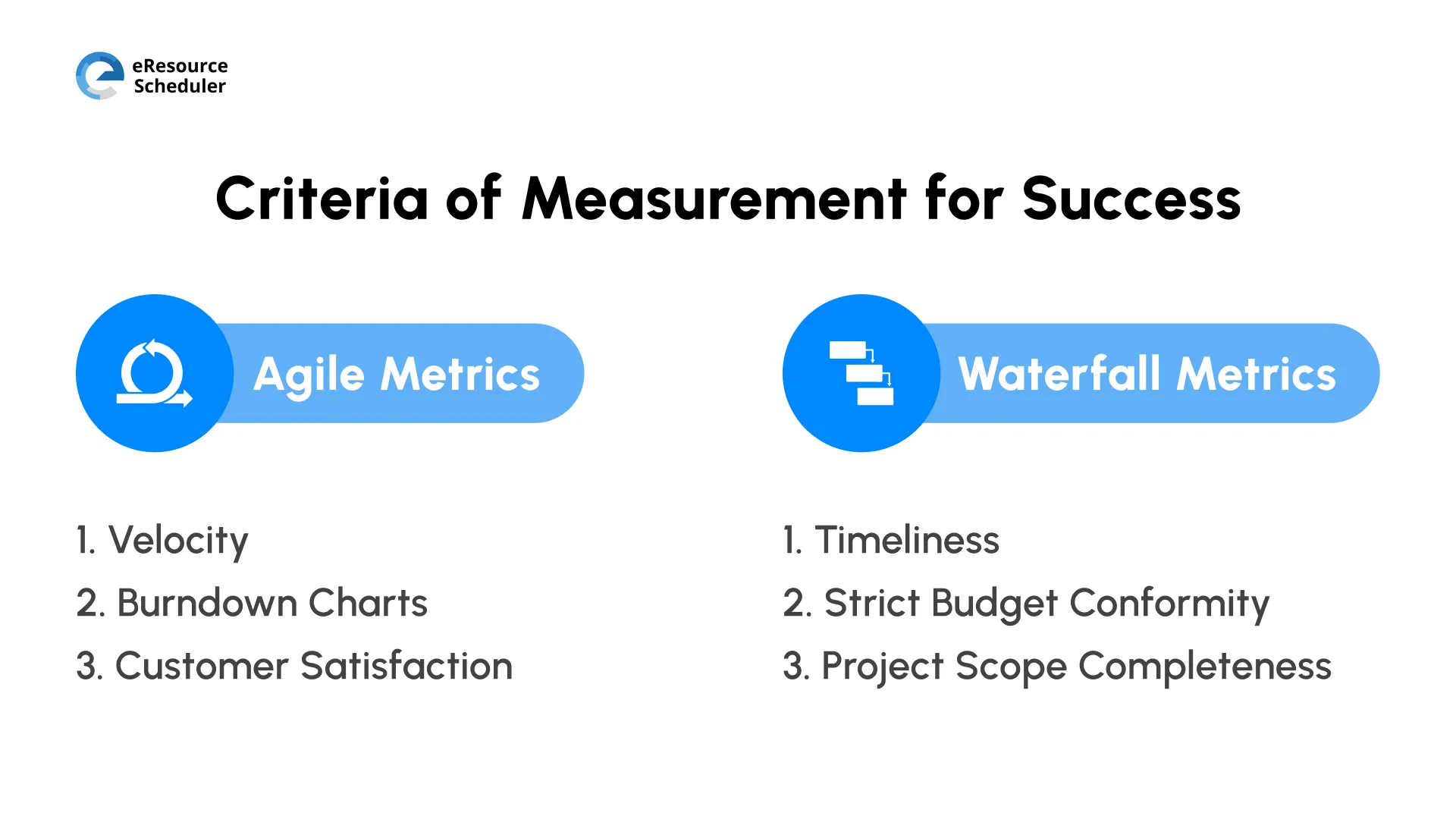
When choosing the right methodology, we have to ask whether it has certain criteria to determine if the project has succeeded.
Because of their respective approaches to project management, Agile and Waterfall each have some unique metrics to evaluate how a project has performed and what results it has achieved.
Velocity, a key Agile metric typically expressed in story points or task units, indicates how much work a team can accomplish during a sprint. In other words, this metric looks at the ability and effectiveness of a team while providing an avenue to track progress over periods.
Often, higher velocity means a happier team member working more productively. However, there are situations where a declining velocity may indicate increasing complexity.
Burndown Charts represent remaining work in time. Burndown Charts help teams track their performance and foresee delays or roadblocks. Whenever the line chart just stays flat or maybe even trends a bit horizontally, that means something's got to be checked out. Work might be lagging, or some glitches might not be right yet.
When there is a big, steep jump up and right on that line, that indicates people are on their jobs and completing stuff very smoothly and rapidly.
Agile iterations are so frequent that customer satisfaction counts as one of the measures. Regular feedback is included within any individual loop so that teams can fine-tune the application to real-world user reactions.
Encouraging feedback from customers and stakeholders along the way demonstrates success, as Agile seeks to produce high-value increments that align with changing customer needs.
An important Waterfall project metric is timeliness. As a Waterfall project follows a well-defined sequential methodology with a number of steps in the process, it indicates the extent to which the project is being completed on schedule.
Budget compliance determines whether the project remains within the cost boundary allocated to it. Budget overruns can be major signs of failing planning or unexpected problems in Waterfall. As the scope and specifications of the project are already drawn before starting.
The scope completeness means that we have delivered everything from what was stipulated and required down to the fine points.
Waterfall projects are very well planned in time, changes in scope aren't common, and often the success of the project is gauged by how well the completed product meets the original requirements.
Agile metrics are more about flexibility, adaptability, and customer satisfaction; Waterfall metrics are more about meeting budgets, timelines, and scope. Both metrics are relevant to determining the measure of effectiveness and success of a project based on the strategy employed.
The honest answer is that the Agile vs Waterfall debate is becoming less relevant by the day. Wellingtone's 2026 State of Project Management Report found that only 36% of organizations consistently deliver projects on time, regardless of methodology. The real question business leaders should be asking is not "Agile or Waterfall?" but "what does this specific project actually need?"
Your choice should be driven by the volatility of your requirements, your stakeholder involvement, and how much room you have to course-correct mid-execution. And once you have made that call, the next bottleneck is almost always resource visibility.
Tools like eResource Scheduler help teams on both Agile and Waterfall projects plan, allocate, and track resources in real time so the methodology you choose actually gets executed the way you intended.
Frameworks do not deliver projects. People with clear goals, the right structure, and the discipline to adapt do. Whether you go Agile, Waterfall, or a hybrid of both, the methodology should serve the work, not the other way around.

Resource bottlenecks, scheduling conflicts, and capacity blind spots derail projects faster than any methodology gap will. eResource Scheduler gives project leaders the resource management backbone to support whichever framework they choose. The best project leaders are not loyal to a framework. They are loyal to outcomes.
1. What is the main difference between Agile and Waterfall?
Waterfall is a linear, phase-by-phase approach where each stage must be completed before the next begins. Agile is iterative, delivering work in short cycles with continuous feedback and room to adapt throughout.
2. When should you use Waterfall over Agile?
Waterfall works best when requirements are fixed, well-documented, and unlikely to change, such as in construction, manufacturing, or compliance-heavy projects.
3. Is Agile better than Waterfall for software development?
For most software projects, yes. Agile handles evolving requirements and faster delivery cycles better. But for large enterprise systems with regulatory constraints, a hybrid approach often performs best.
4. Can Agile and Waterfall be used together?
Yes. Hybrid project management combines Waterfall's structured governance with Agile's flexible execution. Tools like eResource Scheduler make hybrid delivery more manageable by giving teams unified visibility into resources across both workstreams.
5. Which project management methodology is right for my business?
It depends on your project's scope stability, stakeholder availability, timeline pressure, and risk tolerance. There is no universally superior methodology, only the right fit for the work in front of you.

Plan Smarter. Schedule Faster. For Free.
Join thousands already using eResource Scheduler to align teams, time, and tasks seamlessly.
 ALL FEATURES INCLUDED