Learn more
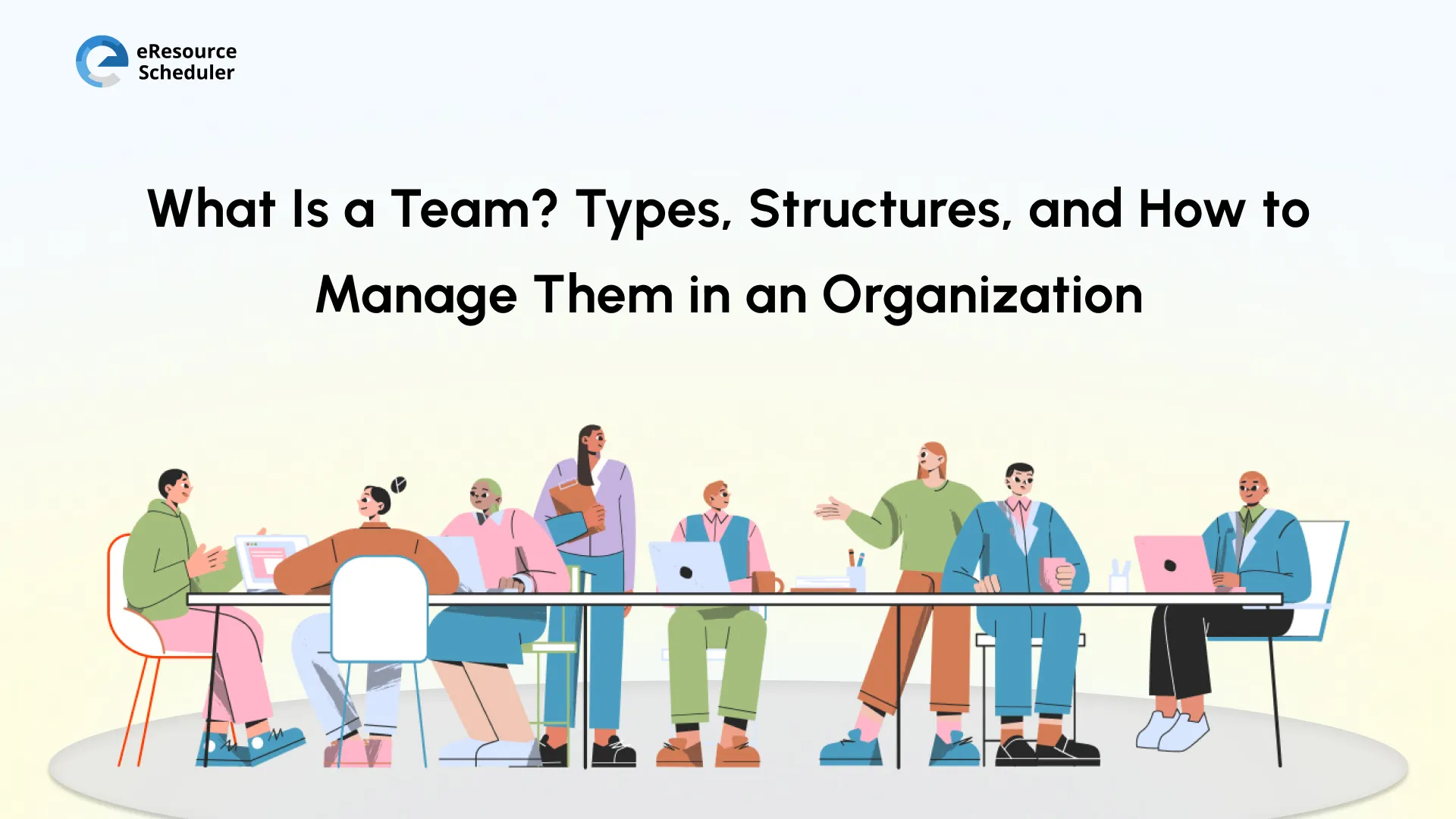
A team is a group of people with complementary skills who share accountability for a common outcome, not just a shared manager or a shared calendar. That distinction shapes everything from how you assign work to how you handle conflict.
In most organizations, not all teams are built the same way. A customer support function runs differently from a product launch task force, which runs differently from a self-directed agile squad. Each has its own strengths, its own failure points, and its own management needs. Treating them all the same way is usually where things start to break down.
This guide covers the five most common types of teams in an organization, what separates high-performing teams from the rest, and how to avoid the coordination problems that slow most teams down.
If you are dealing with resource visibility across team types, see how the right software empowers cross-functional teams.
A team is a group of people with complementary skills who work toward a shared goal and hold each other mutually accountable for the outcome. That last part is what separates a team from a group. A group shares a space or a reporting line. A team shares ownership of a result.
Three things are true of every real team:
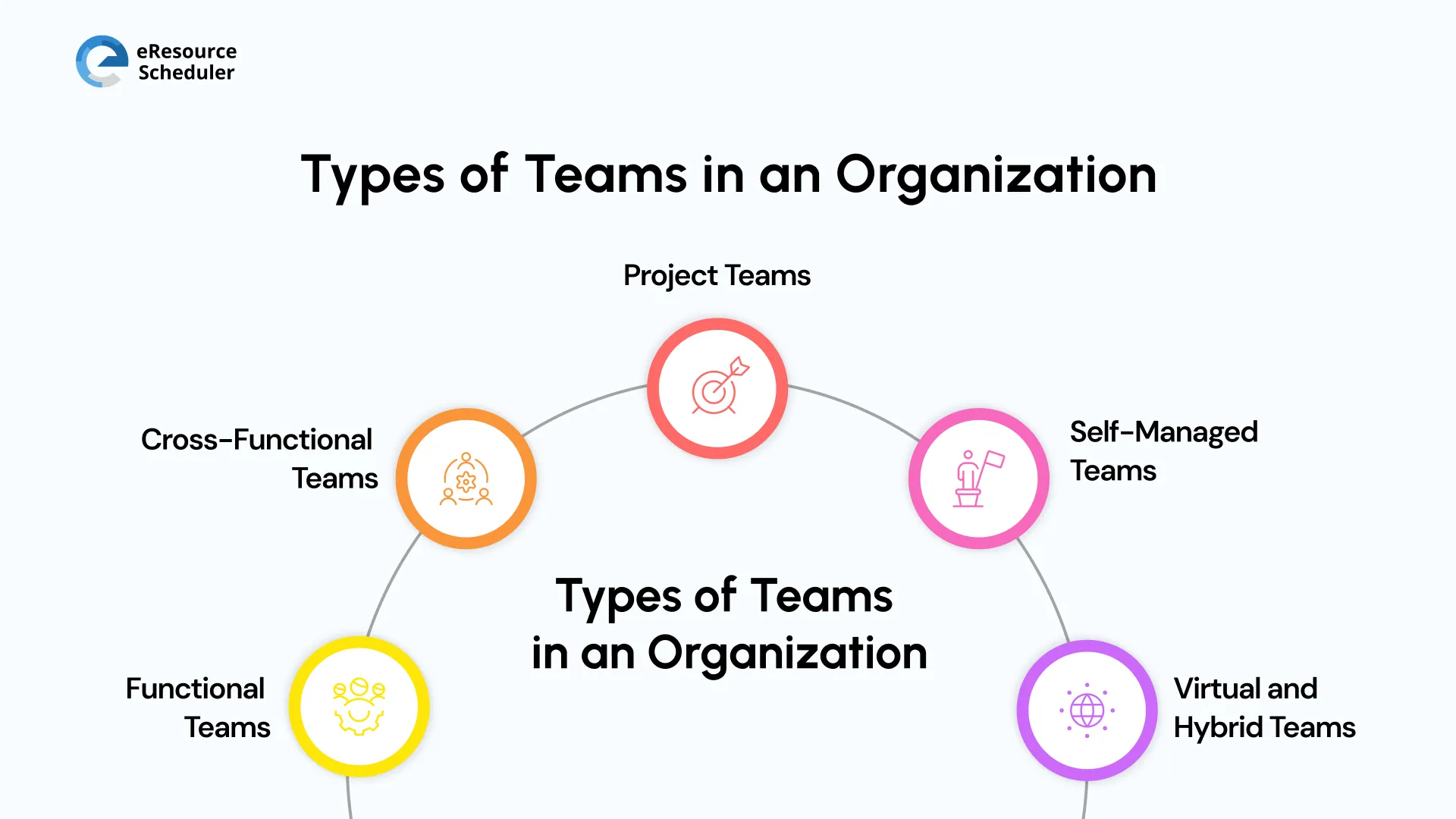
Most organizations run more than one type of team at the same time. Understanding the differences helps you structure work properly, set the right expectations, and avoid the coordination failures that are almost always structural in origin.
1. Functional Teams
Members share the same expertise, report to one manager, and work toward the same ongoing objective. Think finance, HR, or customer support. These teams are permanent and built for consistency. The trade-off is that deep specialization often creates silos that slow cross-department decisions.
2. Cross-Functional Teams
People from different departments come together around one shared goal, such as a product launch, a transformation initiative, or a client engagement. The strength is a diverse perspective. The hidden risk is that members still report to their functional managers, making overcommitment easy to miss and hard to manage.
3. Project Teams
Formed for one deliverable, disbanded when it is done. There is a project manager, a timeline, a budget, and a defined scope.
The people on project teams are almost always borrowed from other departments and often needed in more than one place at once. That is where things fall apart.Resource conflicts are the most common project team failure, and most of them are visible weeks in advance with the right data.
4. Self-Managed Teams
No manager making the day-to-day calls. The team plans its own work, executes it, and holds itself accountable. This works well in mature agile environments where people are experienced and self-directed.
When it works, engagement is high and decisions are faster. When it does not, workload piles onto the most assertive members and the rest pull back quietly. Without a manager to catch it, it can go on for a long time.
5. Virtual and Hybrid Teams
Most teams today are either fully remote or split across locations. The distance itself is manageable. The coordination is harder.
When you cannot see who is on three other projects or who is about to go on leave, conflicts become normal.Remote and hybrid teams face a distinct set of coordination challenges that require actual systems, not just more check-ins.
Here is how all five compare at a glance:
| Team Type | Best For | Breaks Down When | Resource Risk |
| Functional | Ongoing, repeatable work | Priorities shift suddenly | Low |
| Cross-Functional | Multi-department projects | Members are overcommitted | High |
| Project | Time-bound deliverables | Borrowed members get pulled back | Very High |
| Self-Managed | Experienced, autonomous teams | Workloads self-select unevenly | Medium |
| Virtual / Hybrid | Distributed talent needs | Coordination lacks a system | Medium–High |
Pro Tip:
Resource risk refers to the likelihood of scheduling conflicts,
overallocation, or capacity blind spots occurring within each team type.
Team structure determines what a team can do. But structure alone does not make a team high-performing. These five factors consistently separate teams that deliver from those that merely exist.
A Shared and Understood Goal
Clear Roles and Accountability
Psychological Safety
Strong Communication Norms
The Right Mix of Skills

Even well-structured teams run into predictable problems. The leaders who manage teams well are not the ones who avoid these challenges. They are the ones who see them coming.
| Challenge | Why It Happens | Best Practice |
| Resource Conflicts | Same people pulled into multiple teams simultaneously | Confirm availability before committing to anyone. A scheduling tool makes this visible before conflicts happen. |
| Remote Team Misalignment | No shared system for tracking who is doing what and when | Establish a single source of truth for availability and task ownership across locations. |
| Burnout in Overcommitted Members | Cross-functional members carry home department load alongside project load | Cap utilization at 80% and flag overallocation before it becomes a delivery problem. |
| Trust in Temporary Teams | People who have never worked together lack psychological safety | Run a short kick-off that aligns on working norms before the work begins. |
| Role Ambiguity | Multiple departments with no clear ownership of tasks | Define a RACI at the start; who is Responsible, Accountable, Consulted, Informed. |
The right structure and the right people still underperform without the right systems. Here is how to match tooling to the actual coordination problem:
| Problem | Tool Category | Example |
| No visibility into who is available | Resource Scheduling Software | eResource Scheduler (eRS) |
| Tasks falling through the cracks | Project and Task Management | Asana, Jira, Monday.com |
| Communication gaps in remote teams | Async Collaboration | Slack, Microsoft Teams |
| No insight into team performance | Reporting and Analytics | eResource Scheduler, Power BI |
Resource scheduling is at the top of this list for a reason.
Most team coordination problems start the same way. Commitments get made before anyone checks who is actually available. By the time the conflict shows up, it is too late to fix it cleanly.
Tools like eResource Scheduler (eRS) give operations leaders and delivery heads a live view of capacity across every team type. They can see who is available before saying yes, not after.
No team structure is universally better than another. The right choice depends on four questions:
1. What Is the Nature of Work?
Ongoing, repeatable work belongs in a functional team. Work with a clear end date and deliverable belongs in a project or cross-functional team.
2. How Experienced Is the Team?
Self-management works when people are mature, autonomous, and skilled at self-direction. Less experienced teams need clear structure and an accountable manager.
3. Is the Capacity Actually There?
Even the right structure fails if the people you need are already committed elsewhere. Check capacity before you commit, not halfway through the project when reshuffling is costly.
4. How Complex Is the Coordination Need?
One department with clear ownership needs minimal coordination infrastructure. Multi-department, multi-location teams need explicit norms, shared systems, and a single source of truth for scheduling and availability.
Team structure is not a one-time decision. It is something leaders revisit as work evolves, headcount changes, and delivery demands shift. The five team types covered here are not competing models. Most organizations run several of them at once, and the challenge is not picking the right one in theory. It is resourcing each one correctly in practice.
High-performing teams share clear goals, defined roles, and mutual accountability. But even those foundations break down when people are overcommitted, coordination lacks a system, or capacity is assumed rather than confirmed. Structure tells you how the team is organized. Management determines whether it actually delivers.
If you want to see how your teams look with real availability data across every team type, start your 14-day free trial of eResource Scheduler and see the difference live data makes.
1. What is the difference between a team and a group?
A group shares a space, a manager, or a reporting line. A team shares accountability for a common outcome. The distinction matters because managing a group and managing a team require different approaches.
2. What are the most common types of teams in an organization?
The five most common are functional, cross-functional, project, self-managed, and virtual or hybrid teams. Most organizations run a mix depending on the type of work and the structure of the business.
3. What makes a team high-performing?
A shared and understood goal, clear role ownership, psychological safety, strong communication norms, and the right skill mix. Structure enables performance, but these five factors determine whether it actually happens.
4. How do you manage a cross-functional team effectively?
Resolve reporting ambiguity early, define a RACI before work starts, and confirm real availability before making commitments. The most common failure in cross-functional teams is overcommitting members who still carry full loads in their home departments.
5. What tools are used for team management?
Resource scheduling tools for capacity and availability, project management tools for task ownership, and collaboration tools for communication. Resource scheduling is the most overlooked category. It is the one that prevents conflicts before they happen.
6. How do you manage remote teams successfully?
Establish explicit communication norms, create a shared system for visibility into who is working on what, and manage time zones proactively rather than reactively. Remote team coordination fails when leaders assume the team will self-organize without the right infrastructure.


Plan Smarter. Schedule Faster. For Free.
Join thousands already using eResource Scheduler to align teams, time, and tasks seamlessly.
 ALL FEATURES INCLUDED