Learn more

Running a small business in 2026 comes with long days, tight deadlines, and constant decisions that never seem to pause. In the middle of that rush, small business mistakes stack up quietly and usually show up only when a project falls behind or a client starts asking for updates.
Most owners do not realize how early these mistakes start forming or how easily they can be corrected once the patterns are clear.This is where tools like resource scheduling software help bring order to scattered workflows and give you the visibility you usually do not have time to build on your own. When you understand why these mistakes happen, fixing them becomes far more straightforward and much less stressful.
These mistakes show up in almost every small business because the pressure to keep things moving often leaves very little space to step back and plan. When everything feels urgent, smart decisions get replaced with quick decisions.
Every small business starts with good intentions, but things get complicated when you cannot see who is working on what or how much time tasks actually take. That gap becomes the starting point for many daily challenges.
eResource Scheduler is a resource scheduling software that helps businesses see workloads clearly and understand how projects are moving. When visibility improves, decisions become more accurate and far less stressful.
When you are busy, it is easy to assume things are on track. Projects look fine on the surface, but the real issues stay hidden in scattered tasks, disconnected tools, and unspoken workload pressure.
Create one place where all work, schedules, and timelines are visible. When your team can see what is happening in real time, confusion drops and priorities become easier to manage.
Most small businesses start with simple routines, but as work grows, memory stops being reliable. When tasks live in your head instead of a system, things begin to slip without warning.
Move your work into a shared space where tasks, schedules, and updates stay visible to everyone. Once information stops depending on one person’s memory, your entire team becomes faster and more consistent.
Overbooking is one of those issues that appears slowly and then hits hard. It usually happens when work comes in fast and you assume your team can take on just a little more than they actually can.
Small teams do not have extra buffers. When one person takes on too much, delivery dates shift, quality drops, and stress climbs almost immediately. Most owners only notice it once deadlines turn unpredictable or people start feeling drained.
Track actual workloads and plan assignments based on real availability instead of guesswork. When you know exactly who is free and who is stretched, scheduling becomes far more accurate.
Small business owners usually say yes with good intentions. You want to grow, keep clients happy, and avoid turning down opportunities. But constant yes decisions create quiet chaos that builds over time.
Create clearer criteria for what you say yes to. When you understand your real capacity and project timelines, you make decisions that support growth without overwhelming your team.
When everything feels important, nothing actually moves the way it should. Small teams lose time deciding what to handle first, and projects start stretching longer than they need to.
People jump between tasks, urgency replaces strategy, and simple work ends up taking much longer. This creates a quiet drag on productivity and makes your entire workflow feel heavier than it should.
Group tasks by importance, effort, and deadlines. When your team knows what must be done first, daily work becomes smoother and projects stay on track without constant follow ups.
When you do not track workloads, everything feels fine until it suddenly is not. Bottlenecks appear out of nowhere, and projects slow down simply because no one realized how much work was sitting in the pipeline.
Without regular visibility, you rely on assumptions instead of facts. People end up overworked, deadlines shift, and tasks pile up quietly. This is often the moment when teams realize they need tools like resource management software to understand who is available and who is already stretched.
Review workloads weekly and track how much time is going into each project. When you can see capacity clearly, scheduling becomes more accurate and bottlenecks disappear before they grow.
Every small business has peak moments, but most owners do not prepare for them early enough. Workloads jump suddenly, and the team ends up scrambling to keep up with demand.
Busy periods bring unexpected pressure because regular routines cannot handle the extra load. What feels manageable during normal weeks becomes difficult the moment tasks increase.
Look at past projects to understand when your busy seasons typically appear. When you plan capacity in advance, your team stays steady even when work grows quickly.
Many small business owners step into every task because it feels faster than explaining it to someone else. Over time, this creates a workload you cannot maintain and a team that cannot move without you.
You handle sales, delivery, planning, customer questions, and team support all at once. At first it feels manageable, but eventually the pace becomes unsustainable. Decisions take longer, quality starts slipping, and your energy drops before you even realize how much you have taken on.
Delegate the tasks others can handle and keep your focus on decisions that move the business forward. When responsibility is shared, your work becomes lighter and your team becomes stronger.
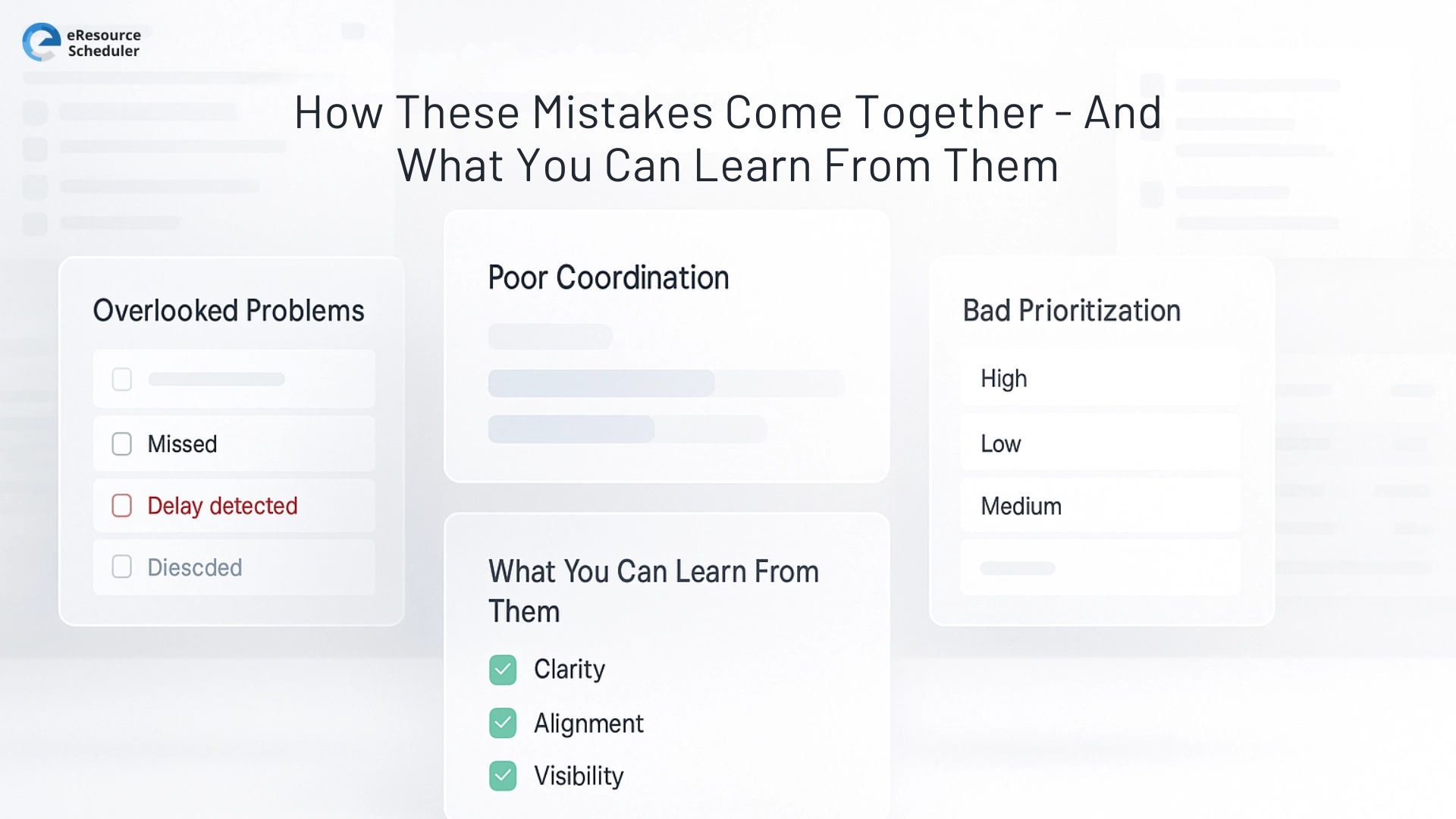
When you look at all these mistakes together, a pattern appears. Most problems start small and grow only because the pace of daily work hides them. The good news is that every issue becomes easier to handle once you can see it clearly and respond before it builds up.
Running a small business is not about squeezing more hours out of your day. It is about finding a rhythm that actually supports you instead of draining you.
When you notice the patterns behind these mistakes and start correcting them one by one, your days feel clearer, your team moves with more intention, and the workload finally starts making sense again.
You think with more calm, you work with more control, and progress feels steady instead of chaotic. And if you ever want a tool that brings this clarity into your daily planning, you can always take the next step and Book a personalized eResource Scheduler demo to see how it fits into the way you work.
1. What mistakes do small businesses make most often?
Small businesses often deal with unclear priorities, scattered tasks, and limited visibility into workloads. These issues grow gradually because daily work moves quickly and owners rarely get time to audit processes. This leads to delays, miscommunication, and stress that could have been avoided with better structure.
2. Why do small business operations break down?
Operations break down when planning is inconsistent and decisions are made without complete information. Without a unified system, tasks move in different directions and problems repeat themselves. These patterns continue until owners start reviewing workflows regularly and building routines that support smoother day to day work.
3. How do small businesses end up overbooking staff?
Overbooking happens when assignments are based on assumptions instead of real workload data. Work arrives quickly, and teams accept tasks without knowing who is already at capacity. Deadlines start shifting, quality drops, and pressure builds before anyone notices how stretched people have become.
4. What helps small teams prioritize work better?
Effective prioritization begins with understanding which tasks have the highest impact. When teams sort work by importance, effort, and deadlines, daily decisions become easier and progress feels steady. Regular reviews help maintain clarity and prevent constant switching between tasks that drain time and energy
5. How can business owners manage stress from daily work?
Stress becomes manageable when owners move away from memory based planning and use a clear system to track work. Delegating tasks, organizing schedules, and reviewing priorities weekly reduces mental load. With better structure, days feel more predictable and decision making becomes far more comfortable.



Plan Smarter. Schedule Faster. For Free.
Join thousands already using eResource Scheduler to align teams, time, and tasks seamlessly.
 ALL FEATURES INCLUDED