Learn more
The majority of organizations struggle with managing their work at the right time, with the right people, and at the right cost. New opportunities keep coming in, priorities keep shifting, and teams are expected to deliver without disruptions.
A full-scale calendar may look promising, but it does not guarantee smooth execution. Many organizations approve work quickly, only to face timeline clashes, double-bookings, and margin shrinks. The gap between opportunity and execution is where a project pipeline becomes essential. It helps bridge the gap between what is coming, what is approved, and what is competing for the same resources.
If you already rely on a structured framework with resource
management software, the pipeline is the operational layer that connects strategy with everyday
execution decisions.
A project pipeline is a structured framework used to track proposed, approved, scheduled, and active projects across different stages of evaluation and execution. It helps organizations visualize upcoming work before commitments are finalized, allowing leaders to assess capacity, prioritize initiatives, and prevent resource conflicts.
Think of it as a living flow of demand entering your organization. It highlights what is coming before commitments are locked in. Unlike a task board that focuses on daily activities, a pipeline works at a leadership level. It answers questions such as:
In recent years, pipelines have expanded beyond client projects. They now include internal transformation initiatives, compliance programmes, and strategic investments. That broader scope makes visibility even more critical.
The terms project pipeline and project portfolio are often used interchangeably, but they serve different purposes.
| Aspect | Project Pipeline | Project Portfolio |
| Purpose | Keeps track of work that’s being considered or is still in progress before final approval | Brings together all the projects that are already approved and part of the plan |
| Focus | Looks at what might come next and what’s still being evaluated | Focuses on what’s already underway or completed |
| Commitment Level | Work is not fully locked in yet, still under review or planning | Resources, budgets, and teams are already committed |
| Decision Role | Helps teams decide what to take on and what to hold back | Helps guarantee everything aligns with business goals and is performing well |
| Resource Impact | Helps avoid overloading teams by forecasting future demand | Shows where resources are currently being used |
| Time Horizon | Looks ahead at upcoming work | Looks at current and past work |
| Strategic Value | Acts as a checkpoint before making financial or contractual commitments | Reflects how well the overall strategy is being executed |
For managers and leaders, the pipeline is a safeguard against overcommitment. It allows feasibility checks before contracts are signed and budgets are finalized.
Most delivery failures take root long before execution. They start when projects are approved. And no one takes a second glance at capacity, skills, and financial impacts.
A defined pipeline helps managers:
When pipeline discussions include financial modeling and capacity planning, leadership conversations shift from reactive problem-solving to futuristic planning.
Hybrid and Distributed Work Models: With teams spread across locations and time zones, you can’t rely on quick check-ins anymore. Managers need a place to see what’s happening across projects, in real time.
Capacity-First Planning: Teams no longer approve work and figure out staffing later. The first question is simple: Do we actually have the right people available when this work is supposed to start?
Integrated Financial Oversight: Before giving a green light, leaders want to know what the numbers look like. Not just revenue, but margins, costs, and whether the project is worth taking on.
Scenario Modeling: There’s more “what if” thinking than before. What if two big deals land at once? What if a project gets pushed? Teams are testing these situations early instead of reacting later.
Industry Insight:
Project performance challenges are more common than most organizations realize. Research from the
Project Management Institute (PMI) shows that only about 73.8% of projects meet their intended business goals. Roughly one in four initiatives still fail to deliver the expected outcomes.
PMI’s earlier Pulse of the Profession® research also found that organizations waste around 11.4% of their total investment due to poor project performance, often caused by delays, scope creep, or budget overruns.
What these numbers highlight is simple: many problems begin long before a project officially starts. When initiatives are sanctioned without carefully estimating capacity, skills, or financial impact, teams end up solving problems during delivery that could have been prevented earlier.
Project pipelines have become a critical governance layer in modern organizations. As project volumes grow and teams operate across departments and time zones, leaders can no longer rely on informal planning conversations or static spreadsheets.
A well-maintained pipeline provides early visibility into incoming demand, helping organizations evaluate priorities, validate capacity, and align project approvals with long-term strategic goals.
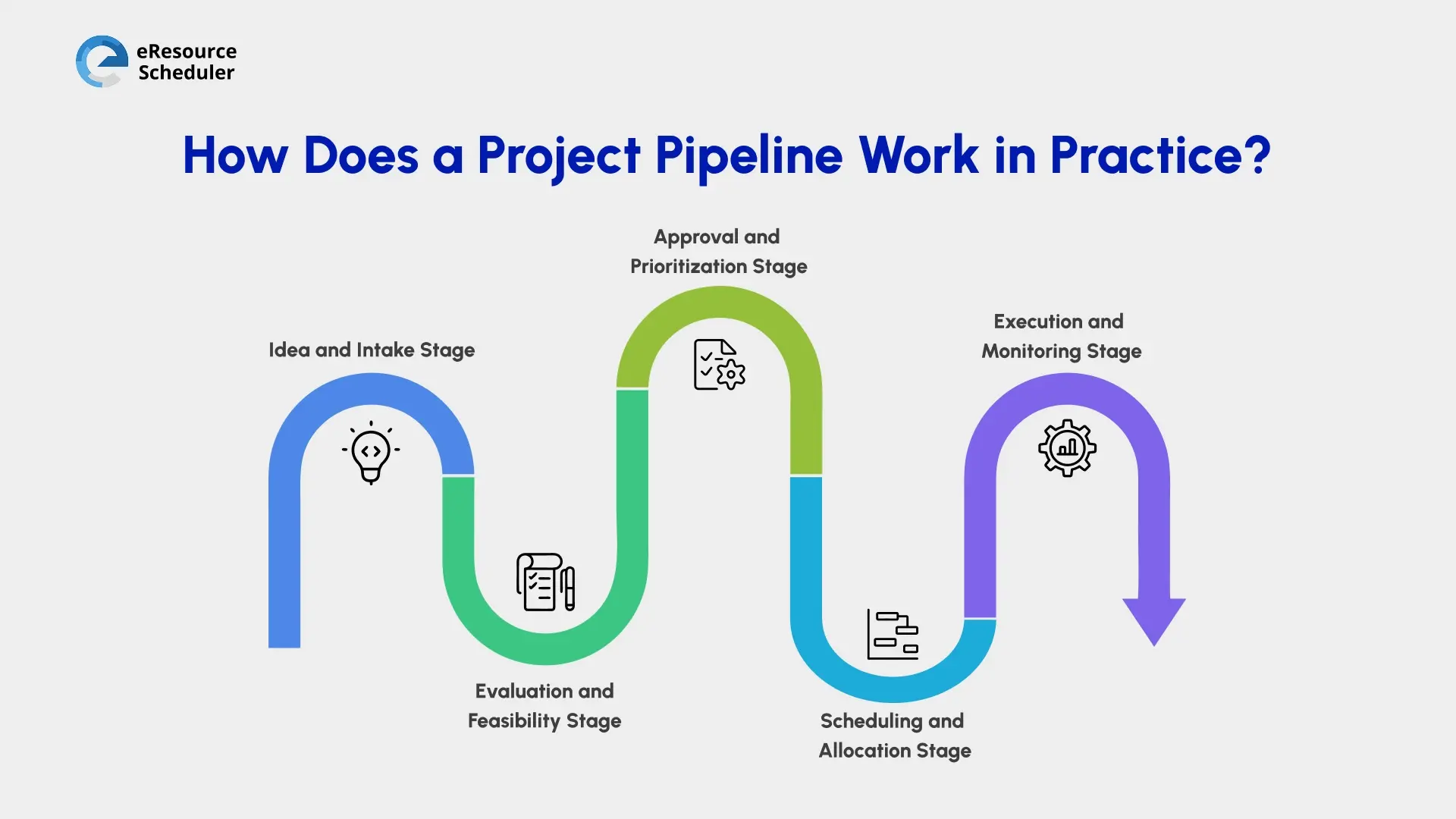
Projects enter through structured requests. Clear intake forms reduce vague proposals and ensure relevant details are captured, such as priority level, required skills, estimated duration, and expected revenue.
Leadership reviews alignment with strategic goals, financial impact, and capacity availability. Early scenario modeling helps avoid unrealistic commitments.
Approved projects are ranked based on urgency, value, and resource feasibility. Not every approved initiative should start immediately.
Specific team members are assigned based on availability forecasts and skill match. Work transitions from planning into delivery.
Projects move into active delivery. Effort is tracked through timesheets and compared against original estimates. This feedback loop improves the accuracy of future pipelines.
A pipeline becomes powerful when connected to real-time availability data. When upcoming work is visible, managers can:
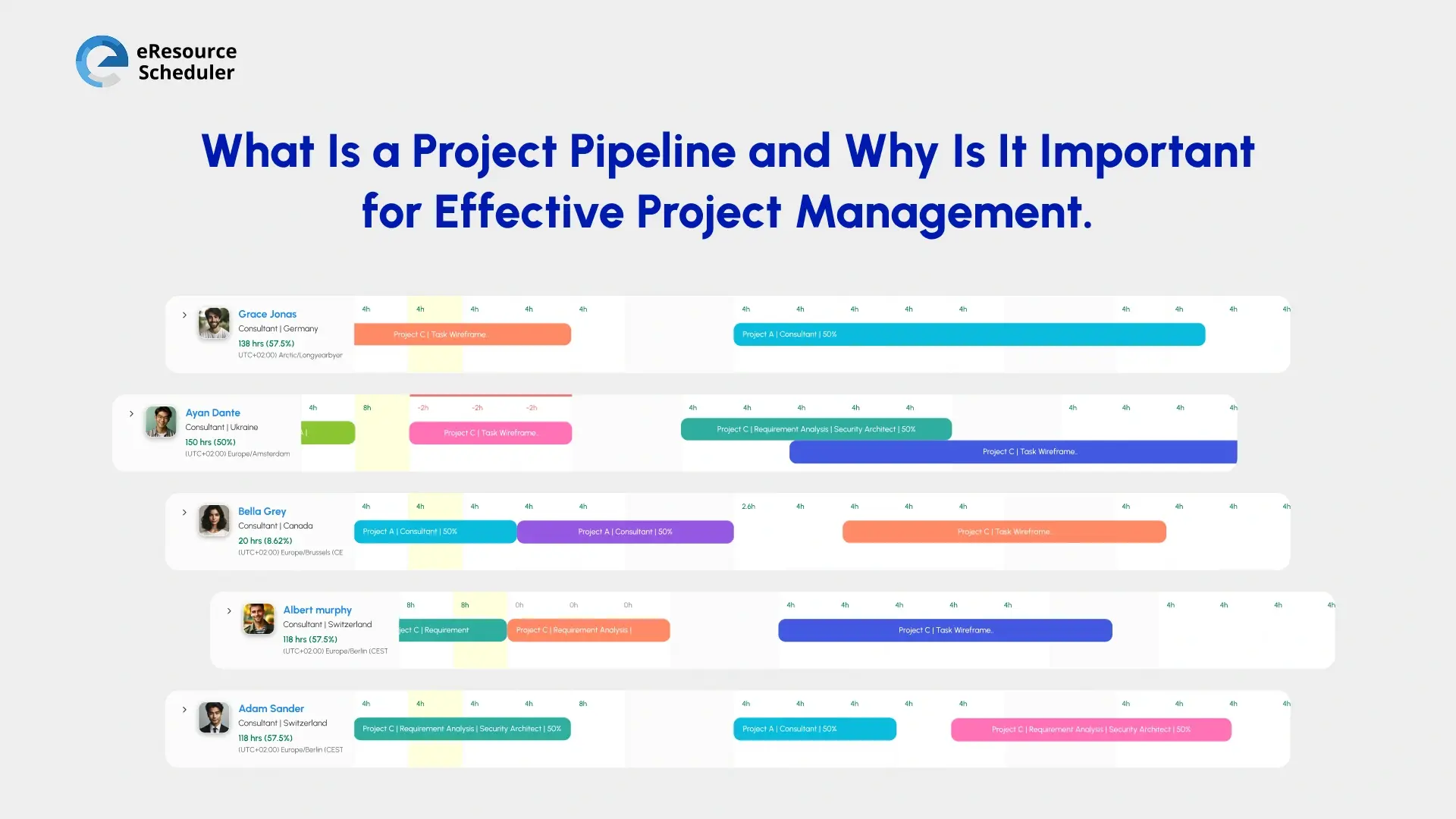
This is where a resource scheduling tool brings structure. Instead of planning projects in isolation, managers view proposed work alongside live assignments and utilization metrics.
Pro Tip:
When two high-priority projects compete for the same senior architect, you don’t want to find out at the
eleventh hour. A tool like eResource Scheduler gives you a clear, real-time view of your entire resource pipeline.
So conflicts surface instantly, not after promises have already been made to the clients.
Less reshuffling, fewer awkward conversations, happier stakeholders.
Ownership depends on organizational size and structure.
What has changed is shared accountability. Sales teams no longer commit to aggressive timelines without visibility into capacity. Likewise, delivery leaders need access to pipeline data to plan staging realistically.
Software such as eResource Scheduler is built for teams that need full visibility into people, projects, and capacity. They combine resource scheduling and planning across multiple projects, forward-looking availability insights, timesheets to compare planned vs actual, financial tracking for cost and margin transparency, management reports for executive review, and cross-project dashboards in a centralized system.

eResource Scheduler supports consulting, IT, engineering, healthcare, marketing, professional services, and other project-driven environments.
Even experienced organizations encounter similar friction points. Manual Reporting. No financial scenario testing. Lack of a single source of truth; weak sales-to-delivery handoffs. Organizations often wait until problems escalate.
Some warning signs include:
A project pipeline does more than manage the current workload. It shapes the future direction. When leaders evaluate potential initiatives side by side, they can:
Combining pipeline visibility with timesheets, financial tracking, and management reporting builds an endless data-driven feedback loop. Estimates become more accurate. Approvals become more disciplined. Growth becomes steadier.
A project pipeline is not just a visual chart. It is a structured decision-making framework that connects strategy, staffing, and financial planning before commitments are made. When integrated with scheduling charts, management reports, and financial data, it prevents overcommitments and strengthens predictability.
Book a personalized demo of eResource Scheduler’s scheduling software today to see how clearer project visibility can support smarter planning decisions.
1. What is the difference between a sales pipeline and a project pipeline?
A sales pipeline trails leads and deal stages before contracts are signed. A project pipeline focuses on prospective and finalized initiatives that will require delivery resources. Both connect at a point or sometimes run parallel, but they serve different operational purposes.
2. How often should a project pipeline be reviewed?
Operational teams often review it weekly to monitor resource impact and new requests. Leadership typically conducts monthly or quarterly reviews to assess strategic alignment and financial performance.
3. Can small businesses benefit from a project pipeline?
Definitely, even small-scale businesses face a shortage of capacity. A structured pipeline prevents overbooking, clarifies priorities, and ensures high-value initiatives receive attention first instead of being sidelined.
4. What metrics should be tracked in a project pipeline?
Common metrics include estimated effort, required skills, projected revenue, expected margin, stage duration, and utilization impact. Comparing planned vs actual effort improves forecasting accuracy over time.
5. How does capacity planning improve pipeline accuracy?
Capacity planning provides forward-looking visibility into availability by role or skill. When integrated with pipeline stages, it helps leaders test feasibility before approving or scheduling new projects.


Plan Smarter. Schedule Faster. For Free.
Join thousands already using eResource Scheduler to align teams, time, and tasks seamlessly.
 ALL FEATURES INCLUDED