Learn more
Employee engagement and motivation are two of the most talked-about topics in the workplace today. For good reasons nonetheless. When even one of the two is missing, the whole team is affected.
Have you ever noticed a colleague of yours doing the bare minimum, clocking out the moment the workday ends, and wondered, ‘What happened to them?’ Chances are, they are disengaged and low on motivation.
If this is happening with your team, this blog is a good place to start. In this blog, we will explain the
what, why, and how of both terms. To get the bigger picture, the right resource
management strategy can shape how your team shows up.
What the Data Says?
According to Gallup’s
State of Global Workforce 2025 Report, only 20% of employees worldwide were truly engaged.
The cost? Approximately $10 trillion in lost employee productivity last year.
Before we look at what to do, let’s first make sure we are on the same page. Because engagement and motivation are not the same.
People often use ‘employee engagement’ and ‘employee motivation’ as if they mean the same thing. They do not. Here is a simple way to tell them apart.
| Employee Engagement | Employee Motivation | |
| What it is | Feeling connected to your work and your team | The push or drive to get something done |
| Focus | Belonging, purpose, and company culture | Goals, rewards, and personal wins |
| Duration | Long-term and steady | Can be short-term or based on one event |
| Driven by | Good managers, recognition, trust | Incentives, goals, and personal ambition |
| Measured by | Retention, survey scores, and absenteeism | Output, tasks done, goals hit |
To understand better, think of engagement as a car and motivation as the fuel. Fuel alone cannot move you, nor can a car. You need both to reach from point A to point B. This is where a manager’s role matters the most.
Good managers are the ones who lead by example. They light the spark and keep the team going. Now, let's see why getting both right is worth your time.
Engaging is not only about making people feel good at work. It has a direct impact on how your business runs.
1. Drives motivation: When someone cares about their work, they do not need a push to get going. They find their own reasons. Engagement creates the inner purpose.
2. Promotes innovation: Engaged employees speak up. They share ideas. Flag problems early. Look for smarter ways to get things done.
3. Better customer satisfaction: When your team is truly invested, customers feel it in the output. You can tell if someone genuinely wants to help the clients by their reactions.
4. Increased profitability: Engaged teams cost less to manage and give you more in return. Not only in terms of money but also in terms of quality. All of these add up to a healthier bottom line.
Understanding why it matters is step one. Step two is knowing what you can actually do about it.
You don’t need a bigger budget or a new HR department to fix things. These eight strategies can come in handy. They are simple, practical, and based on how people actually work.
When someone doesn’t know what ‘doing a job’ looks like, they cannot achieve it. And they can not feel good about what they are doing.
Keep it simple and clear. Tell your team what they need to do. What success looks like. How their work connects to the bigger goal. When people understand the point of what they are doing, they try harder to reach it.
One of the fastest ways to lose a good employee is to bundle them with work when someone else of the same caliber is sitting idle. It feels unfair because it is what it is. When people feel they are treated unfairly, they stop caring and ultimately leave.
Fair workload distribution does not mean giving everyone a mirror. It means looking at who has the time and energy to take on new work and who can’t.
Employees who feel that their work is being recognized are less likely to leave the company. It does not have to be anything big and expensive. A genuine and specific ‘thank you’ and ‘keep up the good work’ in front of the whole team goes a long way.
No one likes being told every single detail of how to do their job. Give your team the freedom to work their way. Even if the deadline and the goals are fixed.
When you trust someone to figure out the best way to reach the goal, you are sending a clear message. I believe in you. This belief is one of the strongest motivators there can be. The more ownership someone is given, the more they care about how their work turns out.
Team engagement is directly proportional to the manager. Not perks. Not company culture. The manager. That means if your managers are struggling, the whole team will feel it. Managers who make their team feel seen create trust. And trust is the foundation of engagement.
Research Extract:
Research involving 210 employees in IT companies found that
transparent communication and authentic leadership were both strongly connected to higher employee engagement.
Employees were more engaged mentally, emotionally, and physically when leaders communicated openly and
consistently. (Hadziahmetovic
& Salihovic, 2022, IJAREM, Vol. 11, No. 2)
Flexible work made its way to the mainstream corporate industry during COVID and is here to stay. But flexibility only works when there is still structure underneath. The goal is freedom with a clear frame around it. Not just an open calendar and crossed fingers.
When employees do not see a path forward at their current job, they start looking for it somewhere else. Sometimes, giving someone a new project, pairing them with a mentor, or making them in charge of a small project also works wonders in upscaling skills. This becomes even more necessary with more Gen Z employees joining the workplace.
When employees understand how their daily tasks connect to a real goal or real outcome, they put more care and energy into their tasks. Share results with your team. Celebrate small wins. When a project closes or a client says something nice, make sure the people who made it happen actually hear about it.
A resource scheduling software, like eResource Scheduler, helps in the background. When you can see workload, capacity, and assignments in one place, you stop guessing. You know who is stretched too thin, who has the room, and how to set fair deadlines. This kind of clear view makes it easier to have honest communication and assign work that fits the schedule.

Strategies look good on paper. But they only work when someone practices them every day. Usually, this someone is the manager.
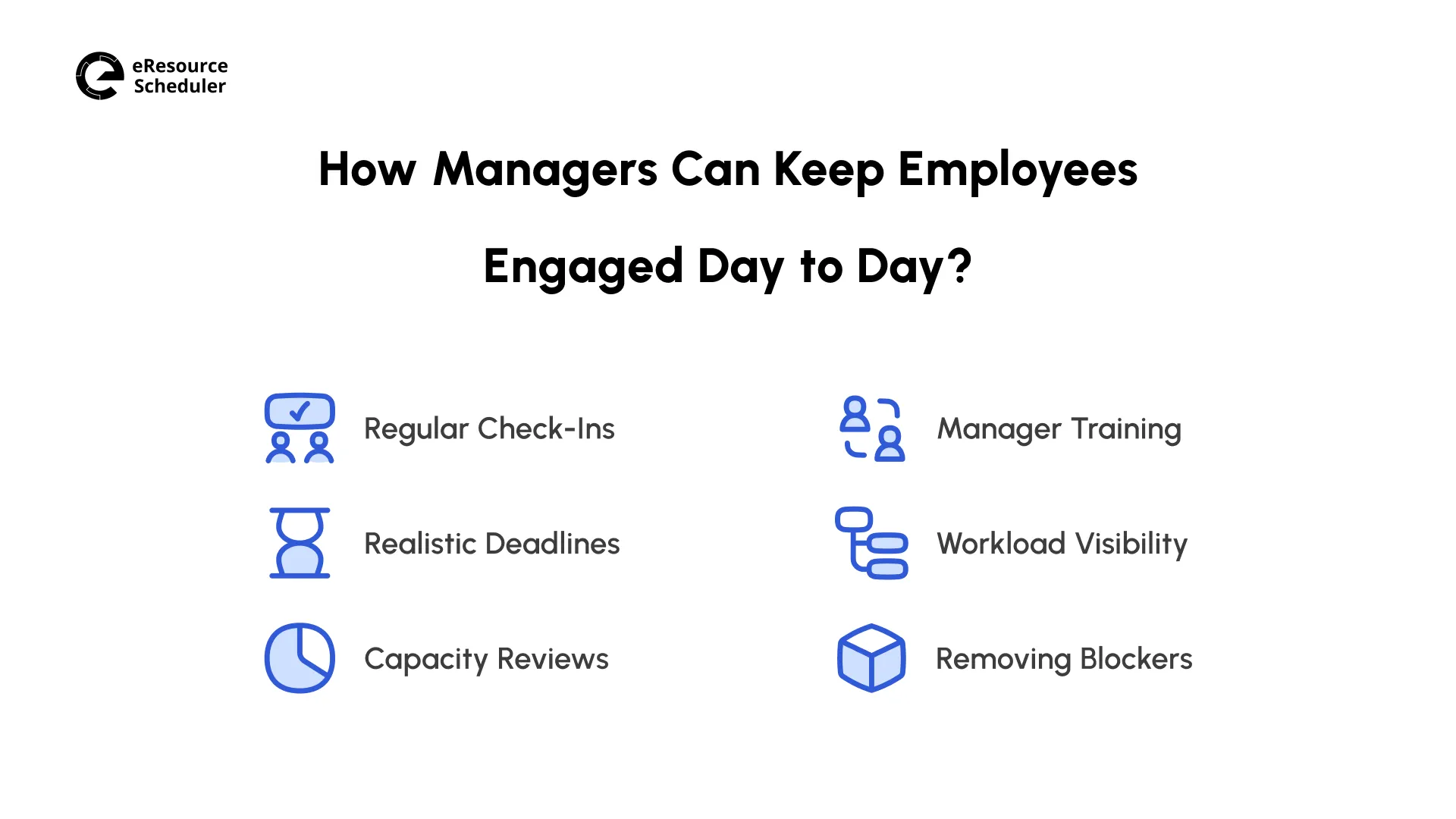
Big strategies give you direction. But what moves the needle is the manager’s deeds. Here is what it looks like in practice.
Ask your team what they need. What is slowing them down? How are they actually doing? Even 15 minutes of genuine attention each week can completely change how someone feels about their job.
A deadline that was never achievable is not a deadline. It is a trap. When managers set timelines without checking their team’s capacity and deadlines, they are setting them up for failure. The teams feel they are always behind schedule.
Before giving someone a new project, check if they have the bandwidth. Skipping this step is the main reason for burned-out people. And when you have frequent burnouts, employees do not stick around for long.
Managing people is a skill. Being great at a job does not automatically make someone a great manager. If you want your managers to keep teams engaged, teach them how to coach, give real feedback, and actually listen.
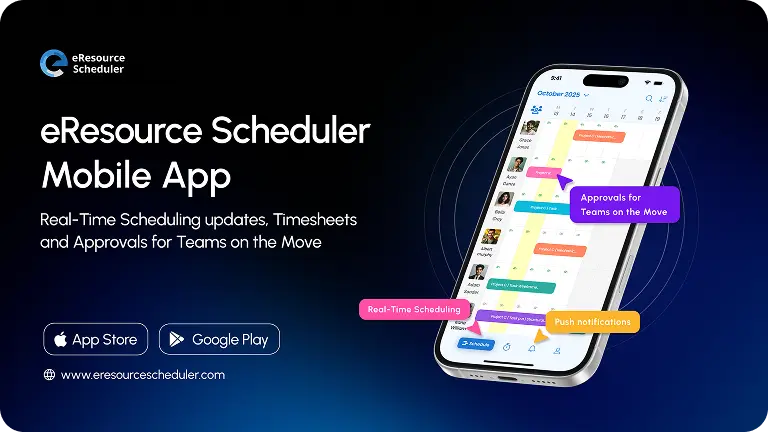
When managers can see how their team’s time is used, they can spot problems quickly. The employee management app from eResource Scheduler extends the web app to mobile. Managers get a live view of who is assigned which task and at what capacity anytime, anywhere. Fixing workload becomes a quick adjustment instead of a last-minute fire drill.
When employees can see their managers putting in the effort to remove the blockers seriously, they trust the process. And trust is a big factor in keeping people engaged.
Keeping people engaged day to day is one side of the coin. The other side is knowing whether any of this is actually working. That is keeping a measure of it.
Before answering the how, first understand the why.
You cannot fix what you cannot see. Checking in on a regular basis helps you catch problems early, track what is getting better, and make decisions based on real data. Not guesswork and instincts.
Before you write a single survey question, get the basics right:
A good survey goes beyond asking if employees are happy. It looks at the things that shape how motivated someone actually feels.
Surveys will tell you how people feel. But if you want to know what is actually happening, track numbers as well.
Look at all these numbers together, not individually. High productivity is good, but when it comes with high absenteeism, it is not a sign to celebrate. It indicates that a small group of employees is carrying too much quietly.
Once you know how to measure engagement, the next step is making sure your tools and systems can create the right conditions for it.
Industry Pro Tip:
Deloitte's Human Capital Trends
Report 2026 confirms that bringing together talent and tech is now a fundamental driver of
performance. Organisations that successfully cultivate adaptive, human-centric approaches are 2.4x more likely
to report better financial results and provide meaningful work.
Engagement is not just culture and feelings. It is also the work setup and cataloguing. When work is messy, unclear, or unfair, even the most motivated person starts to check out.
This is where an all-in-one software like eResource Scheduler steps in. It takes care of the operational side of engagement. The software provides a clear view of capacity, workload, and scheduling in one place. Here is what this looks like in a normal workday.
This kind of transparency directly supports fairer and smarter scheduling. It is one of the top things that employees value the most in a workplace.
Employee engagement and motivation are not problems you can solve for once and move on. They are things you build brick by brick every day.
The companies that get it right are not always the ones with the biggest perks or fanciest offices. They are the ones where people know what is expected of them and feel recognized for their contributions. They have managers who pay attention and help them see how their work connects to the bigger picture.
You don’t have to rush and change everything at once. You can pick one thing from this blog, make it real for your team, and build from there.
1. Why does the difference between employee engagement and motivation matter when hiring?
Motivation is the driver, and engagement is the connection of the driver to the vehicle. You can see motivation during the hiring, but engagement is built after someone joins through culture, management, and recognition.
2. How can I tell if my team is disengaging before they actually quit?
Watch out for the quiet signals. Fewer ideas in the meeting. Shorter replies. More sick leaves. A drop in energy levels. A short quarterly pulse survey is the easiest way to catch them early.
3. What is the return on investing in employee engagement?
The most direct returns are lower turnover, fewer sick days, and stronger output. Calculate what one replacement hire costs your team. Compare it to what a basic engagement platform would run.
4. What is the one thing that kills employee engagement?
When employees raise a concern or share an idea, and nothing happens, trust drops fast and rarely recovers on its own. People stay engaged when their suggestions matter and their voice contributes to something.
5. I am a manager, and my team seems disengaged. But no one is saying anything. Where do I start?
Silence usually means people do not feel safe enough to speak up. Before doing anything, look inward. Are you micromanaging? Have unclear expectations that lead nowhere? Then start with a short anonymous survey. Follow it with one-on-one sessions. Ask open-ended questions and listen to them. The fastest way to rebuild trust is to act on even small things people raise.

Plan Smarter. Schedule Faster. For Free.
Join thousands already using eResource Scheduler to align teams, time, and tasks seamlessly.
 ALL FEATURES INCLUDED