Learn more
Resource tracking is how teams stay honest about their work. Not just who is assigned to what, but whether the allocation actually matches reality, whether capacity is being used well, and whether delivery is on track before problems compound.
For most organizations, that visibility breaks down fast. A project kicks off with a clean plan. Two weeks in, someone takes leave, a scope change comes through, and suddenly three people are carrying the work of five. Nobody catches it until a deadline slips.
According to the Project Management Institute, organizations waste an average of $97 million for every $1 billion invested due to poor project performance. A significant part of that waste traces back to resource visibility gaps, not strategy failures. Separate PMI research shows that only 34% of projects across industries are delivered on time and within budget.
eResource Scheduler is a resource management software that brings resource tracking, project progress monitoring, and capacity planning into one platform. Here is how it works.
1. Clarity about what to scale and exactly when
Projects do not grow in straight lines. Work volume climbs after successful deliveries, and team members who were stretching for a few weeks find themselves permanently overloaded. With resource plans and demand forecasting built in, eResource Scheduler shows you when to hire, what skills to hire for, and whether borrowing from another team fills the gap, before burnout becomes the signal.
2. Multiple filters give you the exact view you need
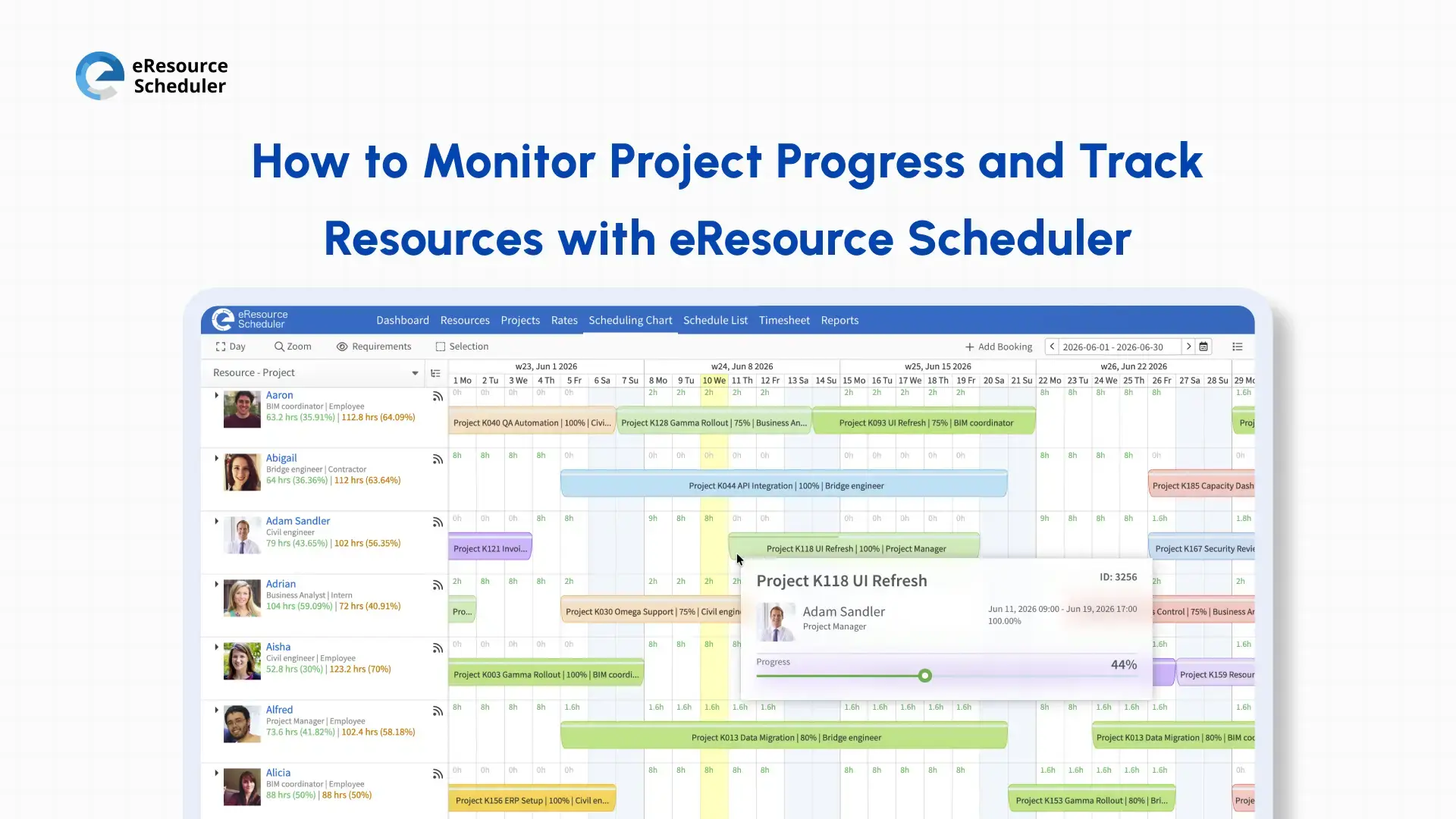
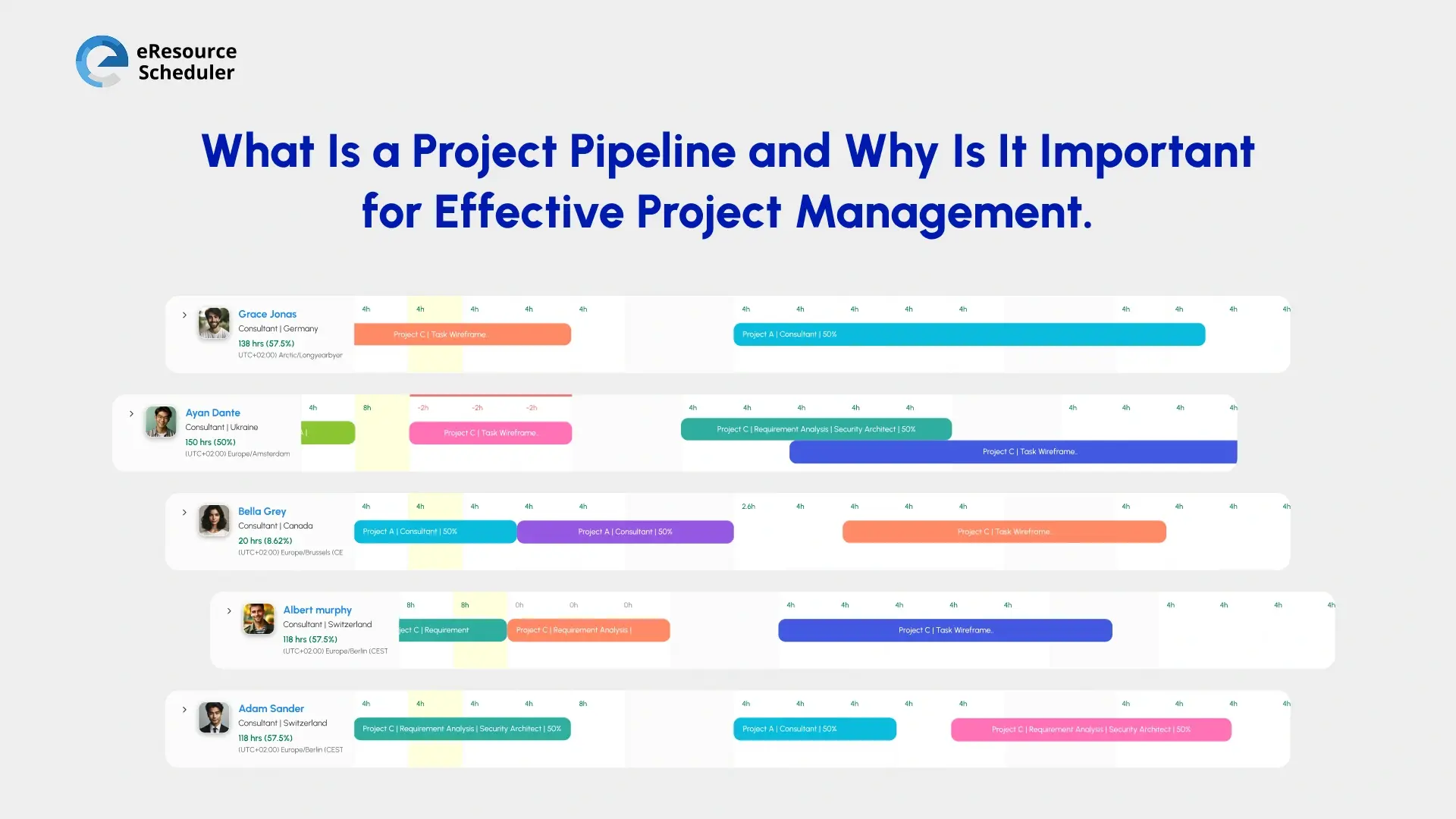
The resource scheduling chart gives you three views: project, resource, and role. Team leads and project managers can build custom views in a few steps, then use advanced filters to match the right people to the right work based on skills, availability, and performance.
For teams spread across time zones and geographies, this is especially useful. Leave plans, capacity, and skill sets are all visible on the same chart, so you are never guessing who is actually available when a new request comes in.
3. Visual overviews, detailed dashboards, and comprehensive reports
eResource Scheduler is a customizable resource management software. Pull reports on availability, productivity, and utilization in a few clicks, and configure dashboards to show each role exactly what they need to see.
Key capabilities include:
• Real-time resource utilization at the individual and team level
• Automated skill matching to assign the right people to the right work
• Filters and colour-coding to instantly flag over and under-booked team members
• Capacity management across multiple projects without switching tools
4. Deliver all your projects on time
Delivering on time is less about pushing people harder and more about seeing clearly. eResource Scheduler gives project managers a view of every active project and every available resource in one place. You can check who has capacity, which projects they are already on, and whether they can take on more. Knowing your project pipeline helps structure these decisions before urgency forces your hand.
5. Accurate forecasting with built-in resource planning tools
Estimating effort is hard. Most teams underestimate it, and the effects show up mid-project when timelines start slipping and budgets get tight. Applying proven practices for resource estimation in project management before scheduling begins can sharpen these inputs significantly.
eResource Scheduler handles this through three built-in tools:
Resource Requirement Feature — define the skills, roles, and headcount a project needs before a single booking is made.
Capacity Forecasting Report — checks demand against your actual available resource capacity, surfacing gaps before they become delivery problems.
Project Progress Report — tracks delivery against plan in real time so the whole team can see where things stand without waiting for a status call.

1. Real-time and updated reports
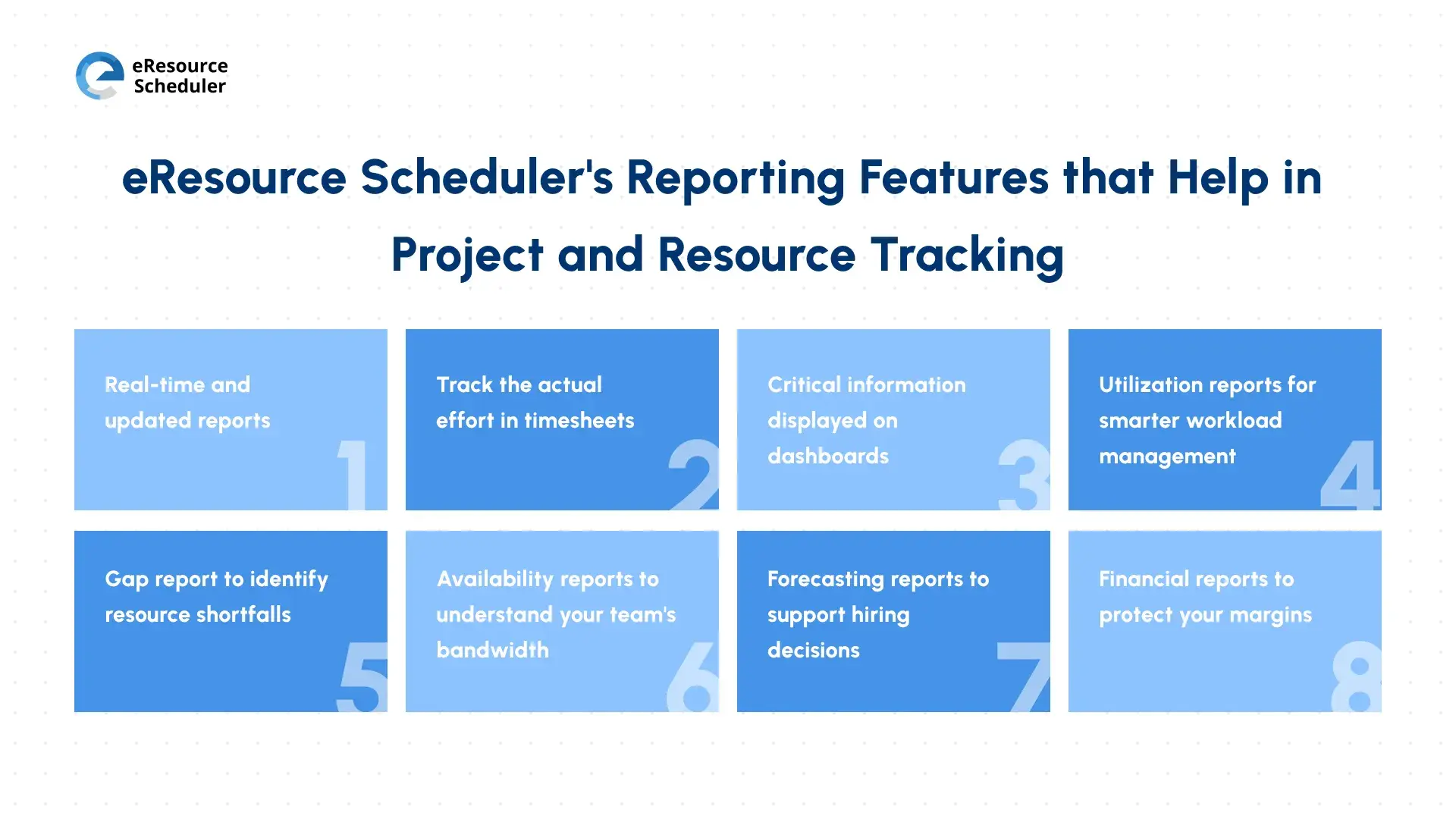
Project managers already spend significant time collating data on utilization, performance, and project status. eResource Scheduler is a resource allocation tool that updates constantly in real time. Every new booking, change, or deletion is reflected immediately across all views. So scheduling decisions are always based on current data, not last week's snapshot.
2. Track the actual effort in timesheets
eResource Scheduler has built-in timesheet software that tracks the actual time team members spend on tasks and projects. Pull timesheet reports across resources and projects, compare planned vs actual utilization, and track cost, revenue and profitability at the resource and project level.
3. Critical information displayed on dashboards
Dashboards in eResource Scheduler are set up to display all key data on one screen and to show what a role needs to see. Resource availability, capacity planning, project tracking, and utilization are all visible at a glance. Risk areas get flagged immediately, so nothing gets buried in a report tab nobody checks.
4. Utilization reports for smarter workload management
Gallup research links chronic overwork directly to elevated burnout rates. Utilization monitoring is not just a performance metric, it is a team health practice. eResource Scheduler's utilization reports deliver organization-wide data in real time, broken down by:
• Resource and project manager
• Team and department
• Individual project
The data tells you exactly how heavily each person is loaded and makes workload balancing a data decision rather than a judgment call.
5. Gap report to identify resource shortfalls
You cannot fix what you cannot see. The gap report compares resource requirements defined at the project level against what is actually scheduled, then flags the difference.
• Shows when and where shortfalls happened, and what type of gap it was
• Configurable and colour-coded for quick scanning
• Can be pulled for any combination of project, team, or time period
6. Availability reports to understand your team's bandwidth
Taking on work without knowing your team's actual bandwidth is a risk. Availability reports show exactly how much capacity each resource has, factoring in current bookings. Viewable at the resource, role, team, or department level, so you always know what is genuinely available before committing to new work.
7. Forecasting reports to support hiring decisions
Resource forecasting turns reactive hiring into planned growth. eResource Scheduler's forecasting report compares high-level resource capacity against demand using project-level requirements and scheduled bookings. It flags upcoming shortages when they will hit, where, and by how much.
8. Financial reports to protect your margins
Resource planning decisions have a direct impact on cost and revenue. eResource Scheduler's financial reports display planned versus actual cost, actual revenue, and profitability across resources, clients, project managers, and projects. Both resource and non-resource cost components are broken out, so you always know where margins are tightest.
Monitoring progress in project management is not about more meetings or more status updates. It is about having the right information at the right time, for everyone involved, not just the project manager.
eResource Scheduler gives project managers, team leads, and resource managers that information. Real-time reports, capacity forecasting, timesheet data, and project progress tracking, all in one platform. No chasing. No guessing.
Ready to bring this visibility to your team? Try eResource Scheduler free. No credit card needed.
1. What is resource tracking in project management?
Resource tracking is the process of monitoring how team members are allocated, utilized, and performed across active projects in real time. It covers availability, actual time logged, capacity gaps, and delivery progress, going well beyond a scheduling chart.
2. How do you track resource utilization effectively?
Effective utilization tracking requires real-time data, not weekly manual reports. Tools like eResource Scheduler pull utilization data automatically and display it at the resource, team, project, and department level, so imbalances can be spotted and corrected before they affect delivery.
3. What is the difference between resource tracking and project tracking?
Project tracking focuses on whether a project is on schedule and within budget. Resource tracking focuses on the people doing the work: their capacity, workload, and performance. The two are closely linked: poor resource tracking is usually what causes project tracking metrics to go red.
4. How do you monitor progress in project management?
Progress monitoring means comparing planned effort against actual effort logged, reviewing milestone completion, and checking resource utilization data across active projects. eResource Scheduler combines scheduling, timesheets, and reporting into a single view so teams can see exactly where each project stands at any time.
5. What reports does a resource manager need for project tracking?
The most useful reports are utilization, availability, gap, forecasting, and project progress. In eResource Scheduler, all five are built in and updated in real time: covering current workload, upcoming capacity, resource shortfalls, and delivery status across every active project.


Plan Smarter. Schedule Faster. For Free.
Join thousands already using eResource Scheduler to align teams, time, and tasks seamlessly.
 ALL FEATURES INCLUDED